Data Access Governance
Data access governance that shows who can open what
See who can reach your sensitive files, who actually opens them, and how they got access, then remove the access nobody needs.
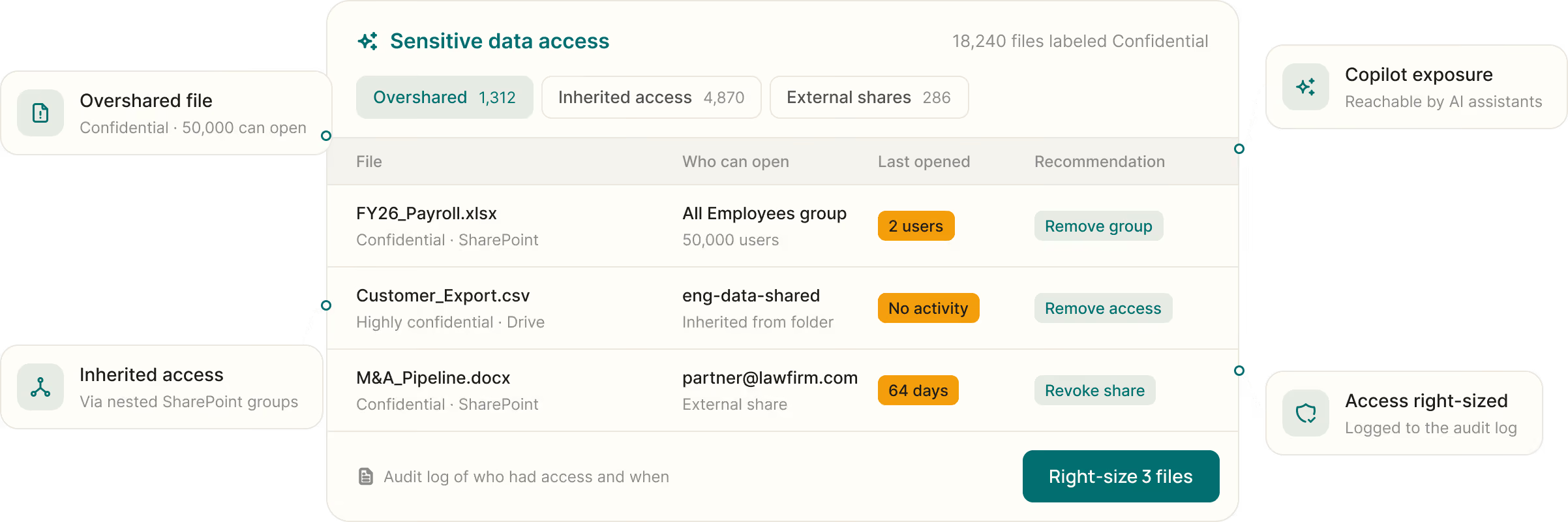
Who can open your most sensitive files?
Access hidden in layers
Permissions stack through sites, groups, and links until no one can say who has access.
Labels without access context
Files are labeled confidential, but no one checks who can still open them.
AI assistants widen exposure
Copilot and other AI tools return whatever a user can open, including files they shouldn't see.
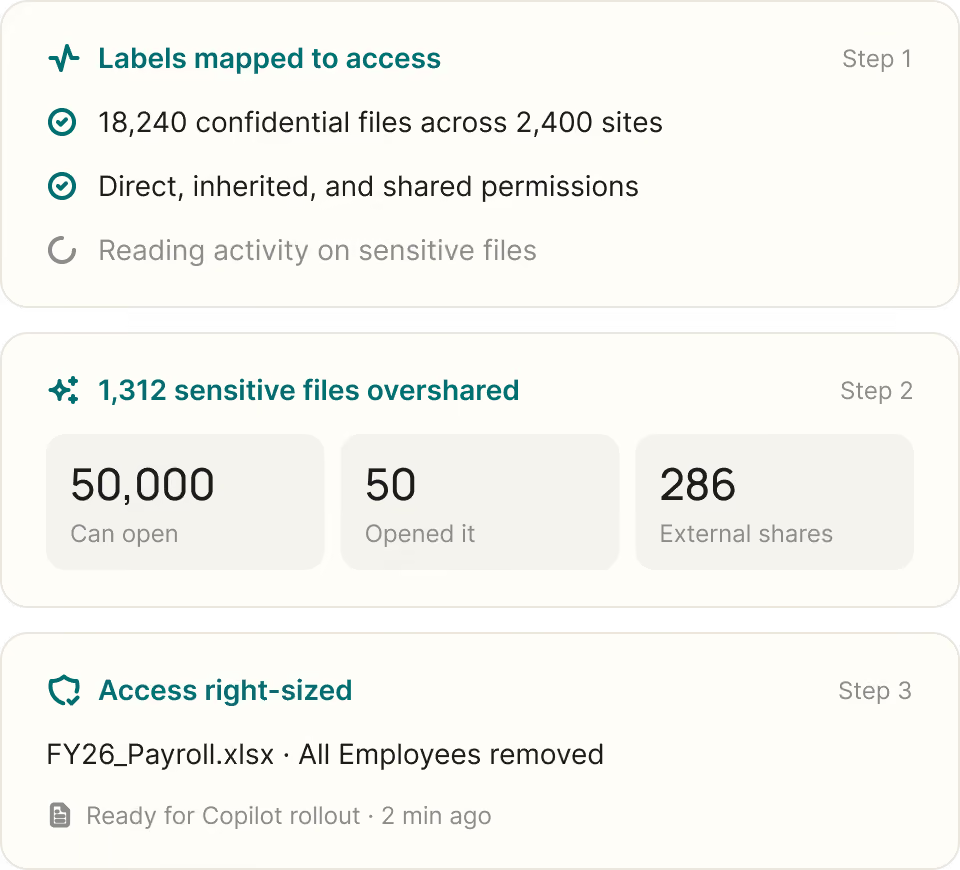

How Oleria governs access to sensitive data

Map sensitive data to access
Pair your sensitivity labels with every direct, inherited, and shared permission across SaaS, cloud, and on-prem systems.

See who actually uses it
Track views, downloads, copies, and shares on sensitive files, so standing access with no use stands out.

Right-size and prove it
Remove dormant users, oversized groups, and risky external shares before a Copilot rollout, with an audit log of who had access and when.
What data access governance changes for your team
For security
Less Sensitive Data Exposed Standing access to labeled files removed when nobody uses it.
For IAM
Every Permission Path in View Direct, inherited, and shared access in one view, not site by site.
For AI programs
A Safer Copilot Rollout Overshared sensitive files found and fixed before an AI assistant can surface them.
For GRC
Proof of Who Had Access A log of who could reach sensitive data, when it was used, and how access changed.
Real customers. Real results.
Security teams use Oleria to clean up excess access, get through audits faster, and bring AI agents under control


Oleria is one of those things that once you see it and get it, it’s hard to imagine doing what you’ve been doing without it.


Being able to assess the current state and optimize around least privilege provides the ROI in itself.And the ability to understand what my engineers need will help us provide least- privilege access

Oleria gives us unparalleled visibility into identity access and usage, saving time and strengthening our compliance posture.

Questions about data access governance
What is data access governance (DAG)?
Data access governance (DAG) is the practice of finding, mapping, and controlling who can access an organization's files and data stores, so access stays limited to what each person needs. Oleria adds real usage and sensitivity labels, so you can see which sensitive data is overexposed and fix it.
What is the difference between data access governance and DSPM?
Data security posture management (DSPM) assesses risk across data stores, such as misconfigurations and exposure. Data access governance focuses on who can open each file or dataset and removes access that isn't needed. Oleria approaches it from the identity side.
Does Oleria use our existing sensitivity labels?
No. Oleria AI is the intelligence built into the Trustfusion platform you already know. The naming gives a clear identity to a capability that spans every workflow on the platform, governance, risk, investigations, access, and the MCP endpoint rather than presenting AI as a separate SKU or a bolt-on feature.
Yes. Oleria maps access against the sensitivity labels already applied in your content platforms, such as SharePoint and Google Drive, so you can see who can reach labeled content.
How does this help with Microsoft Copilot readiness?
Copilot can surface any file a user can open. Oleria shows which sensitive files are overshared before you roll it out, so you can right-size access first.
Which compliance frameworks does this support?
Oleria records who had access to sensitive data, when it was used, and how access changed, to support SOC 2, ISO 27001, GDPR, and internal policies.
Learn more about data access governance
Customer stories and guides on seeing who can reach your sensitive data, and locking it down.