
Identity governance for insurance carriers and brokers
See who can reach policyholder and claims data, from employees and agents to vendors and AI agents, and prove it at every exam.
Get a demo
Who can reach policyholder data in your business?
Govern employees, agents, vendors, and AI agents in one platform, based on what each one actually uses.
Employees and underwriters
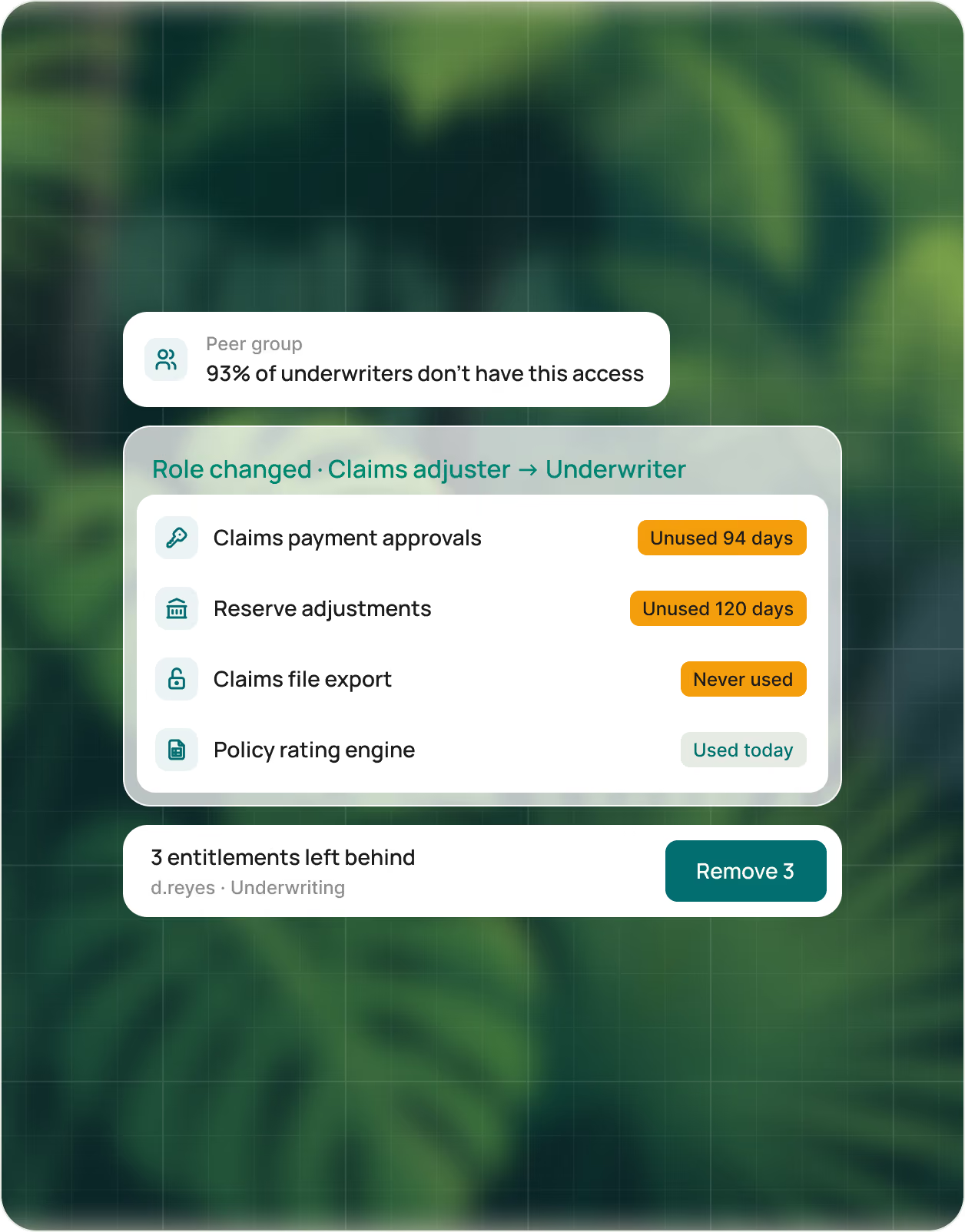
When staff move between claims, underwriting, and finance, old access can move with them. See what each person uses and remove what their role doesn't need.
Agents and brokers
Independent agents and brokers work in your CRM and shared files. See what each one can reach, and end access when an appointment ends.
Vendors and TPAs
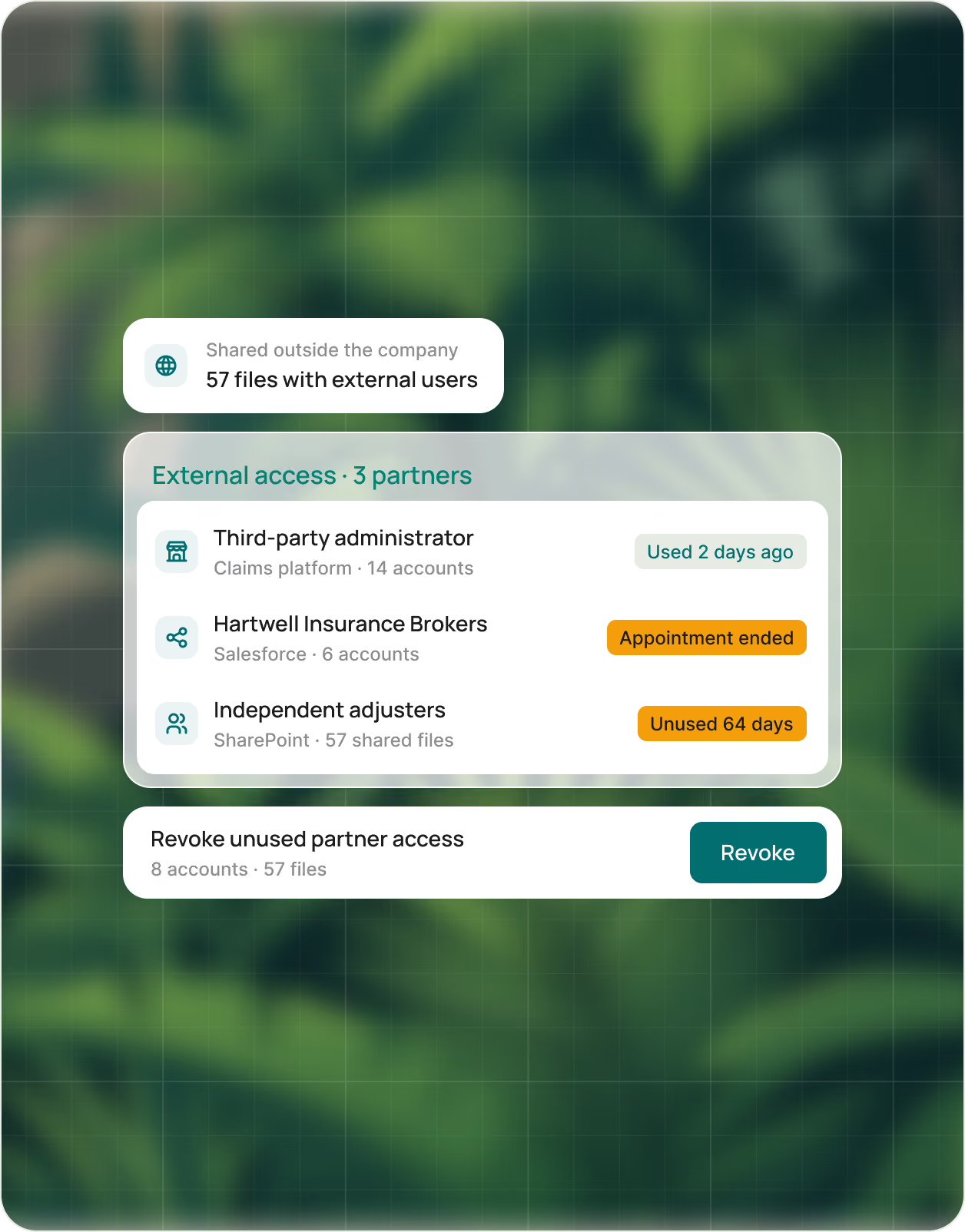
Third-party administrators, adjusters, and IT vendors get accounts and shared links. See external users and revoke access that's no longer used.
Service accounts and AI agents
Integrations, scripts, and AI agents in claims run on service accounts and tokens. See what each one can reach and who owns it.
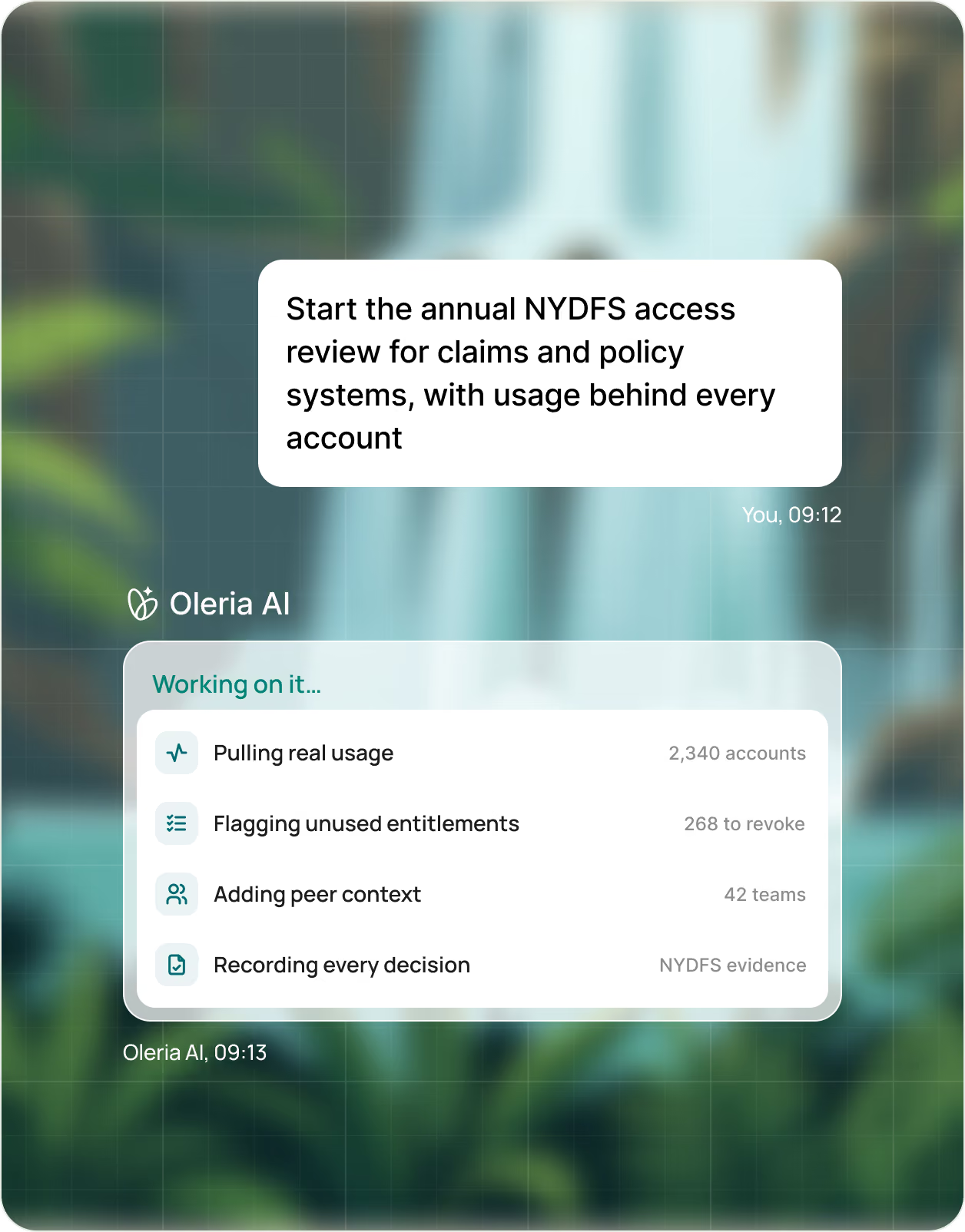
Access reviews
Run annual NYDFS reviews on real usage, with an audit record for every decision.
External access
Find agent, broker, and vendor access that outlived the contract or appointment.
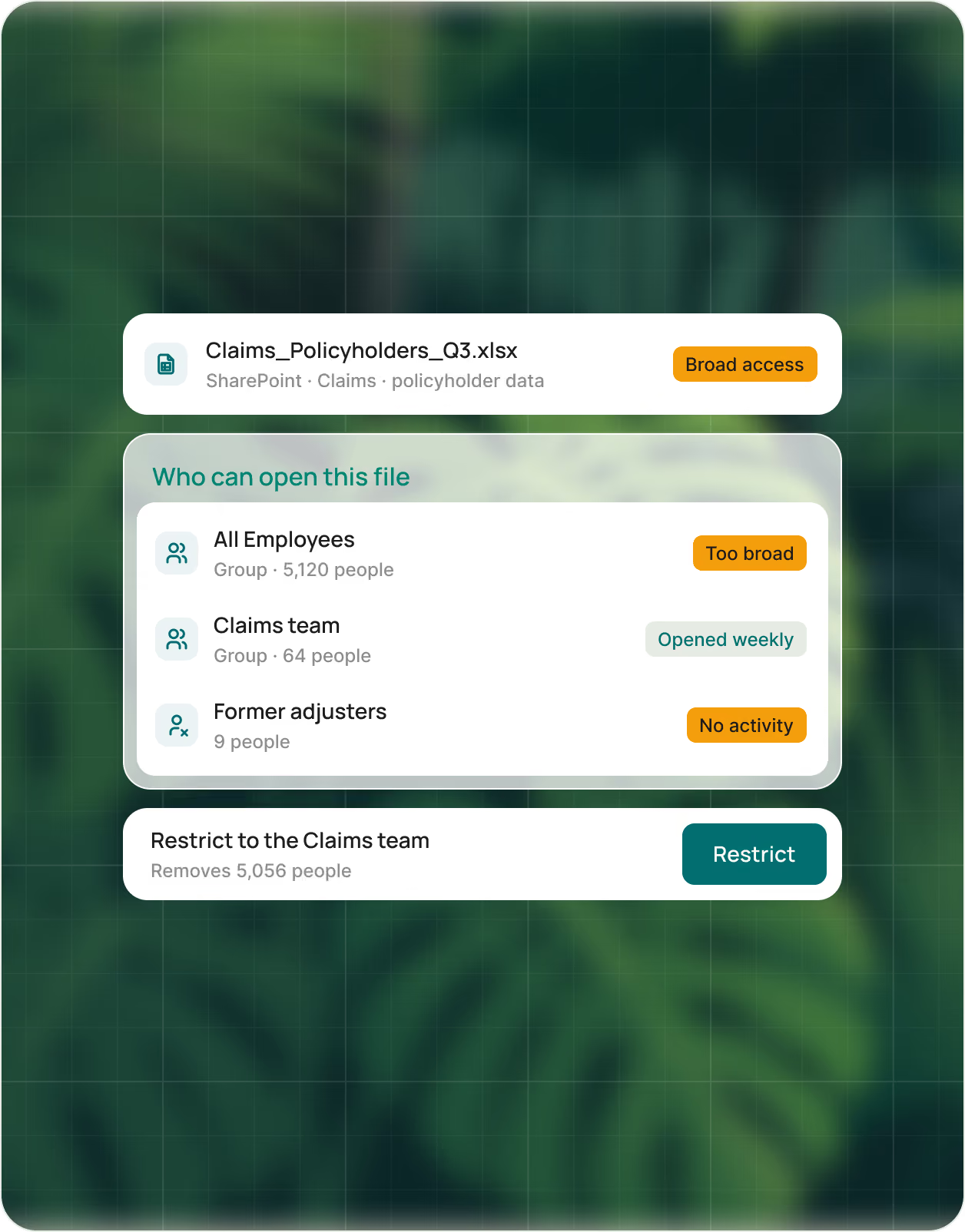
Data access governance
See who can open claims files and policyholder records in SharePoint and drives.
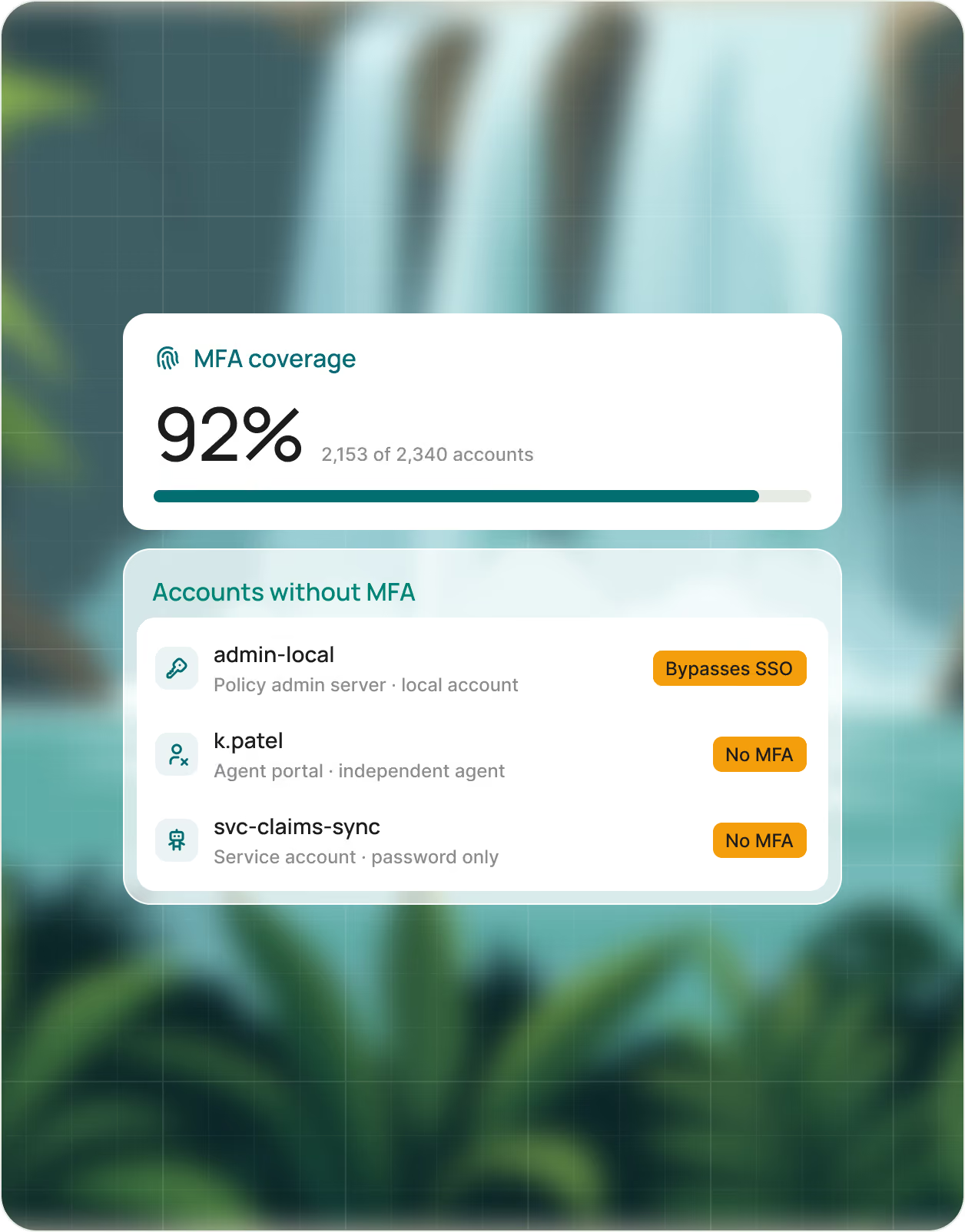
MFA & SSO coverage
Find accounts without MFA, now required by NYDFS for anyone accessing your systems.
Least privilege
Remove unused permissions so access matches what each role actually uses.
Secure AI adoption
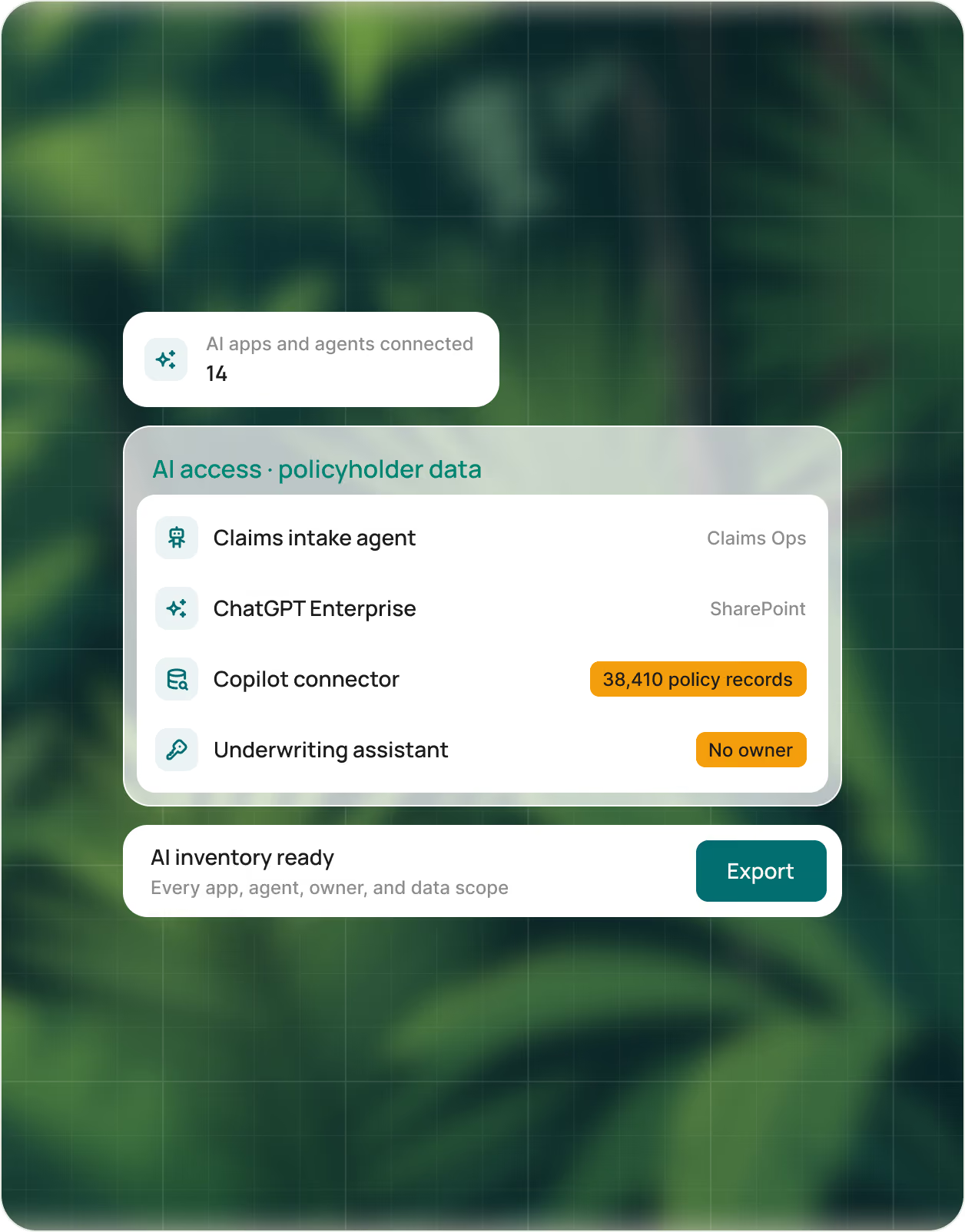
See which AI apps and agents connect to policyholder data, and who owns each one.
Which insurance regulations does Oleria support?
Map each access requirement to the evidence your auditors and examiners ask for.
Questions about identity governance for insurance
What is identity governance for insurance?
Oleria MCP is an MCP server for identity governance. It lets the AI assistants, coding agents, and custom copilots your team already uses query and reason over your identity estate in natural language. No SDK, no new framework, no rebuilt workflows: if your client speaks MCP, it works with Oleria.
Identity governance for insurance is how carriers, agencies, and brokers control who can access policyholder, claims, and financial data. It covers employees, agents, vendors, service accounts, and AI agents, and produces the access reviews and evidence that regulators such as NYDFS expect.
How does Oleria support NYDFS Part 500?
Most platforms layer AI on top of tools designed for static rules and periodic reviews. Oleria AI was designed into Trustfusion from the data layer up — a live identity graph continuously enriched with usage, peer, risk, and authentication context, with Oleria AI's reasoning running as a first-class capability across every workflow on the platform. That foundation is what makes recommendations accurate instead of approximate, and what makes a platform-level MCP endpoint possible.
Part 500 asks covered entities to limit and review user access at least annually, remove access no longer needed, and enforce MFA. Oleria runs usage-based access reviews, finds unused access to remove, and shows which accounts lack MFA
Can Oleria govern access for independent agents and brokers?
No. Oleria AI is the intelligence built into the Trustfusion platform you already know. The naming gives a clear identity to a capability that spans every workflow on the platform, governance, risk, investigations, access, and the MCP endpoint rather than presenting AI as a separate SKU or a bolt-on feature.
Yes, when agents and brokers have accounts in your connected apps, such as your identity provider, Salesforce, or SharePoint. Oleria shows what each one can reach, when it was last used, and flags access that should end.
Does Oleria help with the NAIC Insurance Data Security Model Law?
The MCP (Model Context Protocol) endpoint exposes Oleria AI's reasoning and graph to any MCP-compatible client — Claude, ChatGPT, your internal copilots, or custom agents. Teams can query Oleria in natural language ("show me everyone with prod AWS access who hasn't logged in for 30 days"), pull context into agentic SOC and IAM workflows, and use the result inside the tools they already trust. The endpoint is read-only by design: agents reason.
The NAIC Model Law asks insurers to oversee third-party service providers and control access to nonpublic information. Oleria shows vendors and external users, what they can reach, and lets you revoke what is unused.
Does Oleria govern AI agents used in claims and underwriting?
Access reviews and provisioning, external access oversight, risk monitoring, incident investigations, unused and unintended access detection, and authentication posture monitoring. The same unified graph and Oleria AI reasoning underpin every one of them — which is what makes Trustfusion feel like one platform rather than a suite of point tools.
Yes. Oleria discovers AI agents and the OAuth apps connected to your systems, shows what data each can reach and who owns it, and records the actions they take.
Learn more about identity governance for insurance
Customer stories and guides on protecting policyholder data and proving access controls to auditors.