The intelligence layer built into Oleria's identity security platform.
Oleria AI is the intelligence running across every workflow on it, reasoning over continuous streams of access, usage, and risk signals, and turning them into the recommendations and findings your team needs to make decisions.
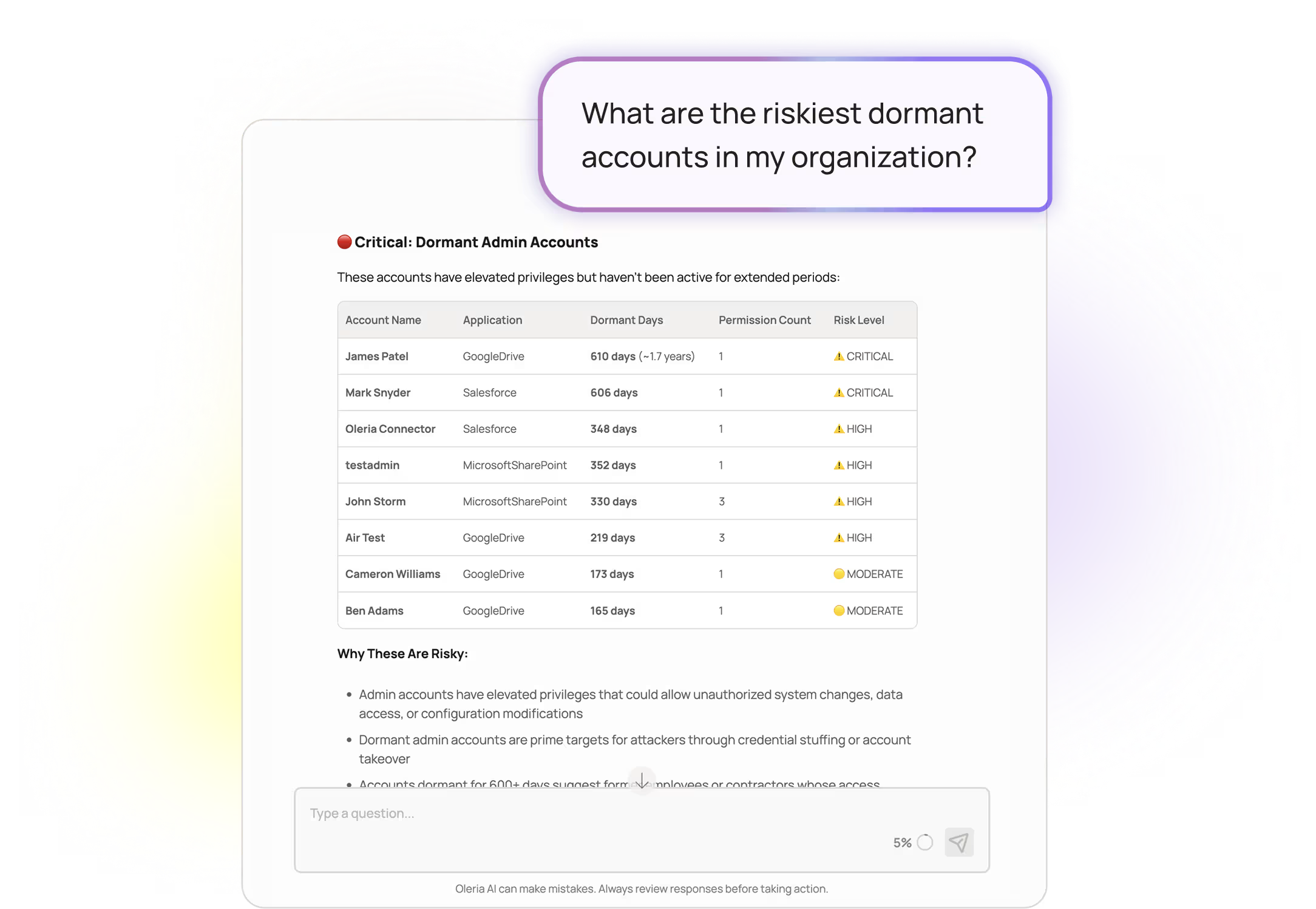
Identity security that reasons so your team can make smart decisions fast.
Across every Oleria workflow
Access reviews and certifications, risk monitoring, incident investigations, external access, account and group utilization, unused-access detection — all running on the same Oleria AI reasoning, on the same live graph. Not five AI features bolted onto five tools. One AI, every workflow, every team that touches identity.
A natural-language chat experience for any identity question
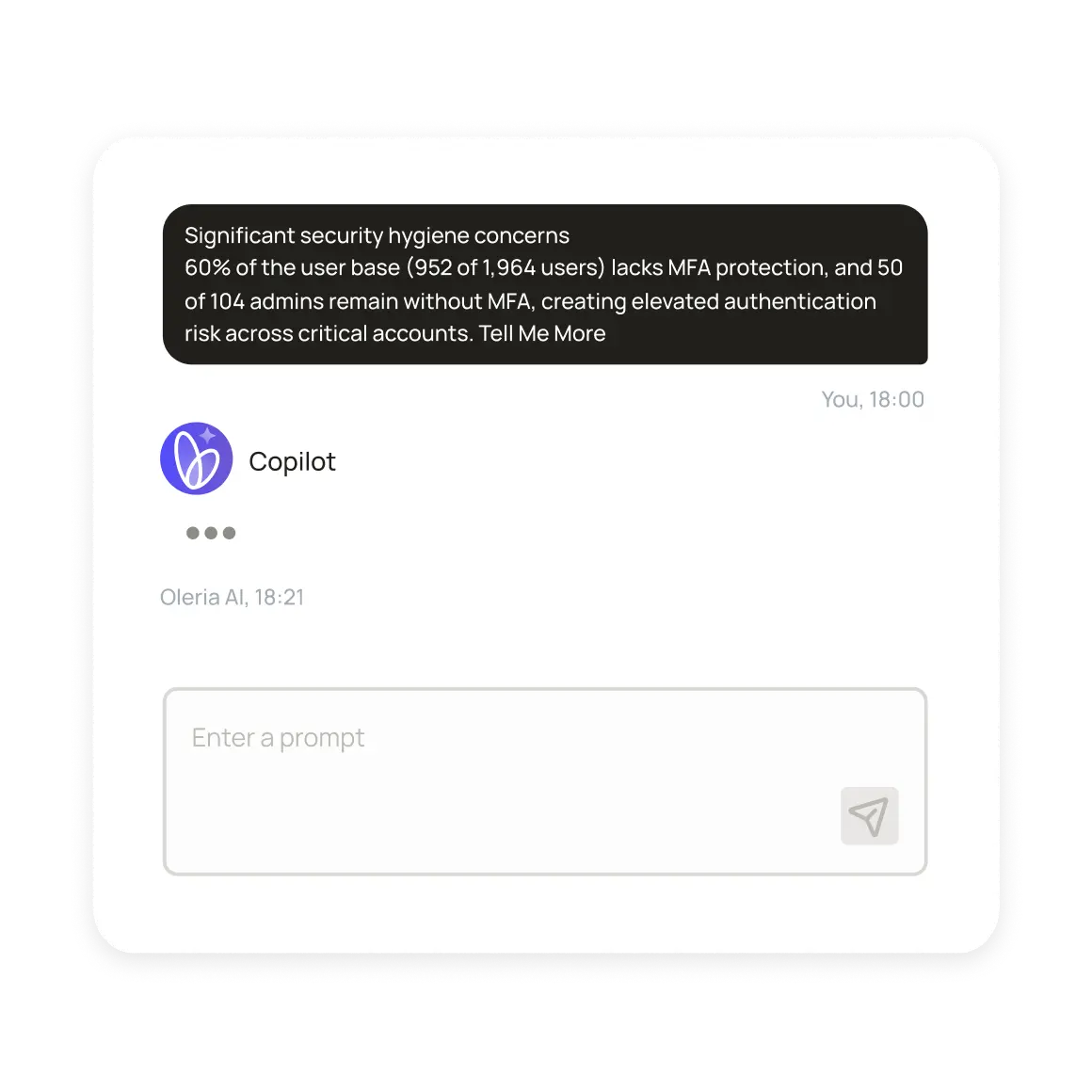
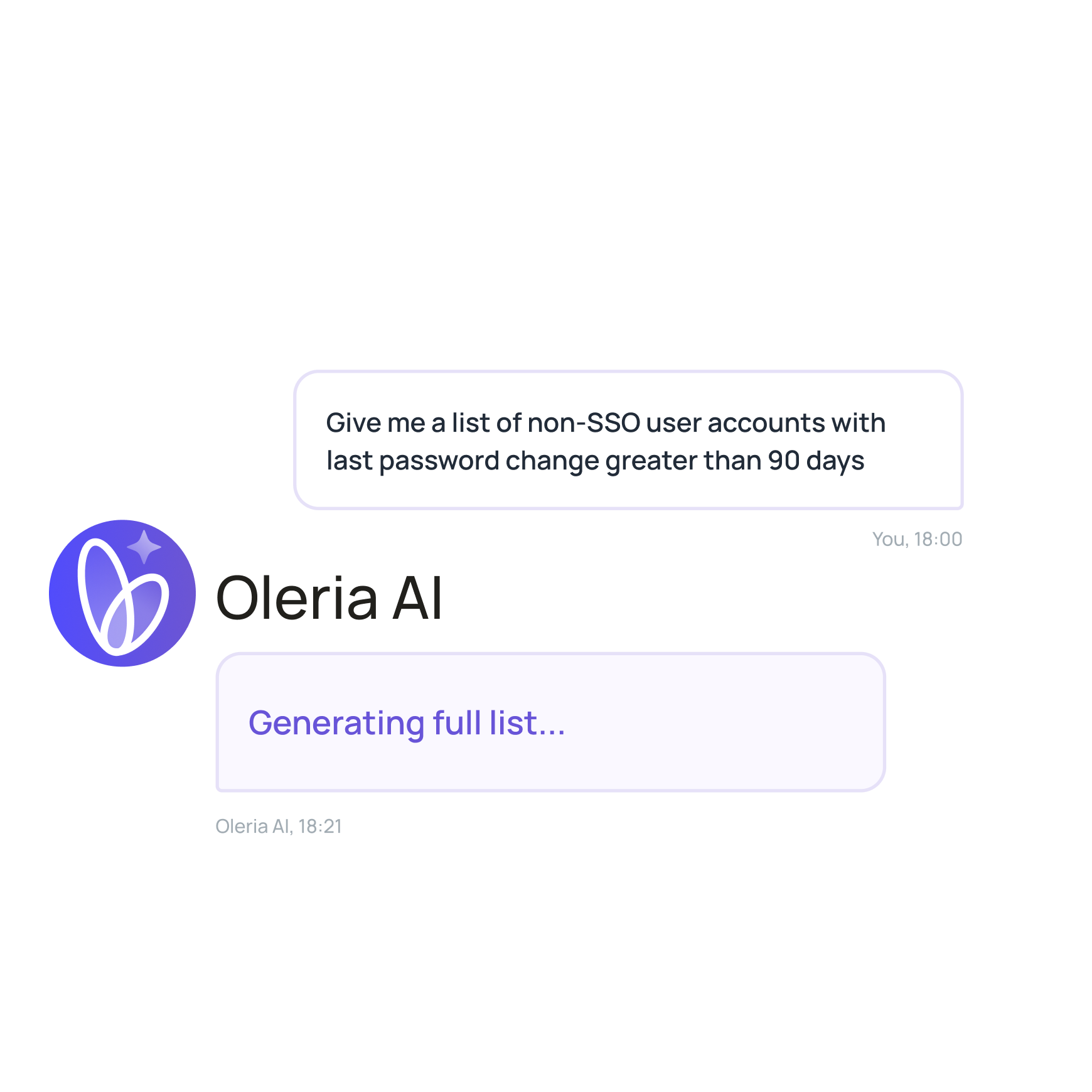
Oleria AI brings the same reasoning into a chat experience built into Trustfusion. Ask who has access to what, why it was granted, what's unusual, what to do about it, in your own words. Every answer is backed by Oleria’s access graph & usage intelligence, so reviewers, investigators, and auditors get from question to defensible answer in seconds.
Open to your agentic stack via MCP
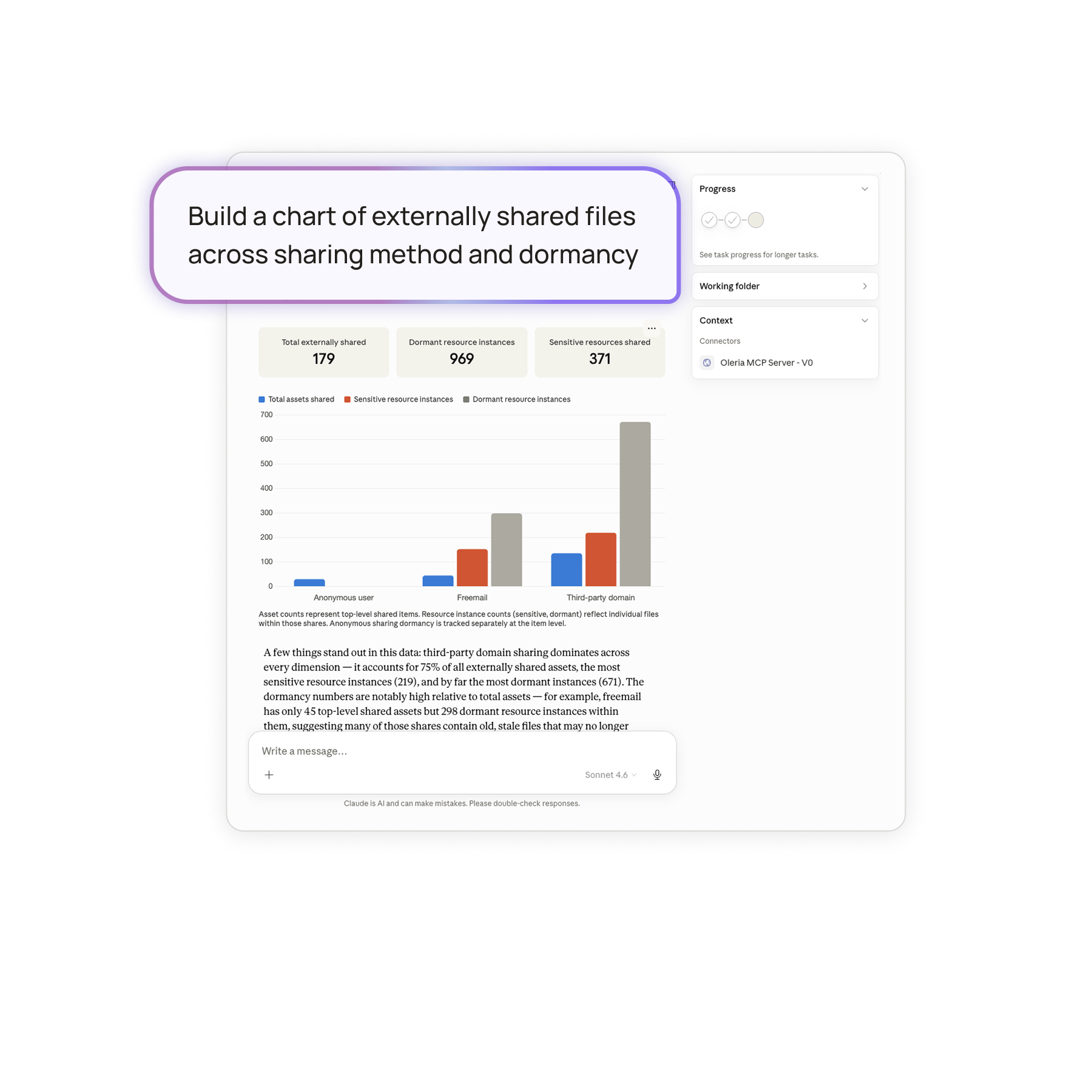
The same Oleria AI reasoning is exposed through the MCP (Model Context Protocol) endpoint, so Claude, ChatGPT, Cursor, and the copilots your team built in-house can query the platform natively. Read-only by design, audited end-to-end. The intelligence you trust inside Oleria is the intelligence your agents use outside it.
Supervised by design, explainable end-to-end
Oleria AI reasons; your team's governance workflows are what acts. Every recommendation comes with the reasoning behind it — peer group, usage, dormancy, risk factors. Oleria’s audit trail captures every action taken under it. Powerful signals to help your team decide.
.webp)
.webp)
One AI. Every identity. Every app.
Oleria AI reasons across your entire identity estate: on-prem, cloud, SaaS, and custom apps.
Oleria FAQs
What is Oleria AI, and how is it different from Trustfusion?
Trustfusion is Oleria's identity security platform — the live identity graph, connectors, and workflows. Oleria AI is the intelligence layer built into Trustfusion: the reasoning that runs across every workflow, from access reviews to incident investigations to the MCP endpoint that agents use. Trustfusion is what you deploy. Oleria AI is how it thinks.
What makes Oleria AI different from security platforms that claim AI features?
Most platforms layer AI on top of tools designed for static rules and periodic reviews. Oleria AI was designed into Trustfusion from the data layer up — a live identity graph continuously enriched with usage, peer, risk, and authentication context, with Oleria AI's reasoning running as a first-class capability across every workflow on the platform. That foundation is what makes recommendations accurate instead of approximate, and what makes a platform-level MCP endpoint possible.
Is Oleria AI a new product?
No. Oleria AI is the intelligence built into the Trustfusion platform you already know. The naming gives a clear identity to a capability that spans every workflow on the platform, governance, risk, investigations, access, and the MCP endpoint rather than presenting AI as a separate SKU or a bolt-on feature.
What does the MCP endpoint do?
The MCP (Model Context Protocol) endpoint exposes Oleria AI's reasoning and graph to any MCP-compatible client — Claude, ChatGPT, your internal copilots, or custom agents. Teams can query Oleria in natural language ("show me everyone with prod AWS access who hasn't logged in for 30 days"), pull context into agentic SOC and IAM workflows, and use the result inside the tools they already trust. The endpoint is read-only by design: agents reason.
What workflows does Oleria AI cover beyond access governance?
Access reviews and provisioning, external access oversight, risk monitoring, incident investigations, unused and unintended access detection, and authentication posture monitoring. The same unified graph and Oleria AI reasoning underpin every one of them — which is what makes Trustfusion feel like one platform rather than a suite of point tools.
How does Oleria AI make recommendations, and how do I trust them?
Every Oleria AI recommendation comes with explainable reasoning — the peer group considered, the usage observed, the dormancy signal detected, the risk factors weighed. Your reviewers, requesters, and auditors see the full reasoning before they decide. Trustfusion logs every decision and every workflow action taken under it for audit.
Does Oleria AI take actions on my identity estate?
No. Oleria AI reasons, surfaces, scores, and explains — it does not provision, revoke, approve, or modify anything on its own. Your team's governance workflows are where action happens. Any automation (for example, auto-revoke at the end of an access review campaign) is a workflow you configure, informed by Oleria AI's signals. The MCP endpoint is read-only by design as well: agents reason; they never act.
Does Oleria AI replace my IdP, my HR system, or my SIEM?
No. Oleria AI sits alongside the infrastructure you already have — Okta, Microsoft Entra ID, Workday, your SIEM, and so on and acts as the unified intelligence layer across them. You keep your stack. We add the reasoning.How does peer-based intelligence stay accurate as the org changes?Peer cohorts are recomputed continuously by Oleria AI as attributes shift. When a team reorganizes, when a new tool rolls out, when a role redefines itself — Oleria AI updates its view automatically. There is no static role library to maintain.
Can my team automate revocation and other actions, with Oleria AI in the loop?
Yes — through Oleria’s governance workflows, not through Oleria AI itself. Common patterns include auto-revoke at the end of an access review campaign for incomplete or rejected reviews, scheduled deprovisioning for departed employees, and scheduled clean-up of clearly unused entitlements. Oleria AI provides the reasoning that justifies each action while the workflows execute it under your policy, with a full audit trail.
Elevate identity security with AI
Oleria gives you AI-powered capabilities to bring identity security up to machine speed. Oleria’s conversational LLM gives you immediate answers to your complex identity questions, while AI-powered continuous learning broadly analyzes usage patterns to provide rich context for smarter, faster decision-making.