Adaptive Identity Governance built on a unified platform
Deploy governance in hours, not years on a trusted platform that scales from 10 employees to Fortune 10 companies. Oleria delivers unmatched access intelligence – always on, so your team doesn't have to be.
.avif)

.avif)
Unmatched access intelligence, rooted in a data-first, AI-native foundation.
Trusted: Secure. Comprehensive. Always on.
Oleria’s infrastructure scales seamlessly and securely, governing identities across your entire digital estate on one data-first, AI-native platform. Pre-built integrations go deeper, pulling context-aware access intelligence that drives faster decisions, so every action is trusted and defensible.
Fast & easy: From zero to governed in under an hour.
In under 60 minutes, Oleria unifies your entire hybrid identity estate—on-prem, cloud, SaaS, and custom apps—into a single intelligent governance plane, fueling smart automation and faster access decisions from Day 1. No multi-year rollout, and no armies of consultants needed.
Capital efficient: Maximum ROI. Minimal TCO
Because Oleria deploys in under an hour, you start seeing value from Day 1—and skip the million-dollar consulting engagements. Once live, it runs lean. Smart automation handles the heavy lifting, eliminating the need for costly professional services or ongoing manual reconciliation. You see ROI sooner, with a TCO your CFO will love.
Context aware: Put an end to rubber-stamped access reviews.
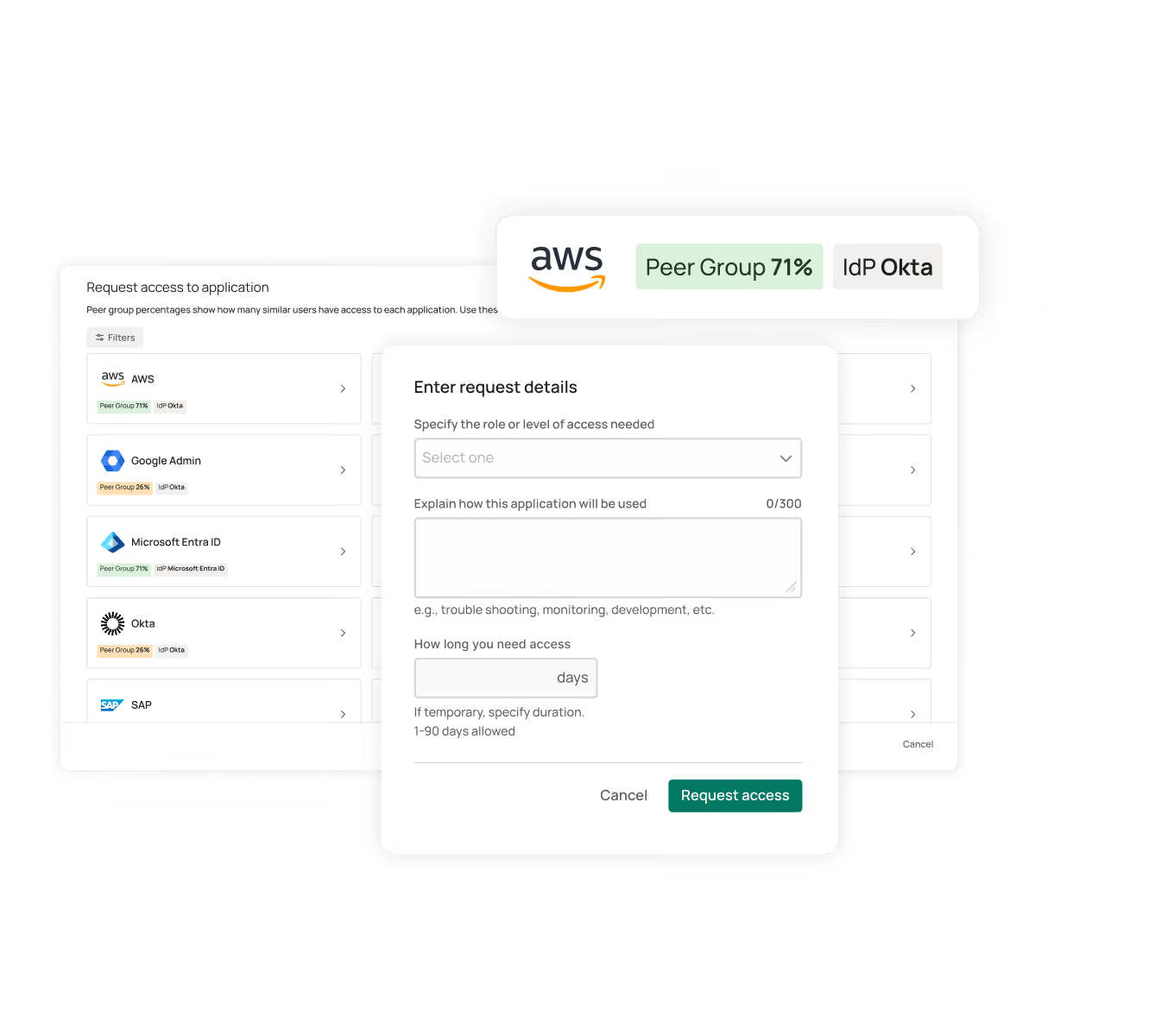
Every reviewer has the rich access insights, peer comparison, and actual usage context they need to make confident decisions on every recommendation, workflow, and access review. AI woven into Oleria’s fabric turns that context-aware access intelligence into adaptive and increasingly autonomous governance decisions.
Productive: Identity governance that works for everyone, not just IT.
When modern governance works, everyone wins. Employees receive the access they need without the wait. Managers approve with real usage context instead of cryptic entitlements and guesswork. IAM and IT teams onboard and offboard users at scale. GRC teams shift from gathering evidence to managing risk. Auditors pull reports on demand. And CISOs get unified visibility and control across the entire identity estate. Your team can finally focus on high-impact work.
.avif)
.avif)

“Oleria gives us the identity intelligence other platforms just can't. We've moved from periodic, manual reviews to continuous insight and control. What used to be a fragmented, high-friction compliance exercise is now streamlined, defensible, and aligned with how our business actually operates – without the steep services costs and overhead that legacy IGA platforms typically require.”
.svg)
.svg)
Govern every access point across your entire identity ecosystem.
Oleria governs access across your entire identity ecosystem. Native integrations deliver deep visibility into permissions and usage, while SCIM extends coverage to 300+ additional apps. We built the infrastructure you need, so you get complete visibility from day one—without costly consultants or drawn-out deployments.
IdP
Orchestrate provisioning across your Single Sign-On (SSO) ecosystem. Automatically grant and revoke access as employees join, change roles, or leave. (Okta, Microsoft Entra ID, PingOne)
HRIS
Turn employee data into automated triggers. Route new hires, department transfers, and terminations into access workflows, no manual tickets required. (Workday, SAP SuccessFactors)
SaaS
Govern where work actually happens. Conduct access reviews, approve requests, detect excessive permissions, and reclaim dormant licenses automatically. (ServiceNow, Salesforce, GitHub)
Cloud
Secure the infrastructure layer. Manage permissions across multi-cloud environments, prevent overprivileged access, and enforce least-privilege at scale. (AWS, Azure, GCP)
Directory
Bridge modern governance to legacy systems. Apply consistent access controls across on-premises and cloud environments without gaps. (Active Directory, LDAP)
Oleria FAQs
What makes Oleria different from legacy IGA solutions?
Traditional IGA relies on static roles and manual rule-building, a process that is slow to deploy, expensive to maintain, and constantly falling out of date.
Oleria introduces Adaptive Identity Governance, a fundamentally new approach built on the AI-native Trustfusion platform and a data-first identity foundation. Instead of relying on static policies, Oleria continuously analyzes how access is actually used across your environment.
Oleria enables organizations to:
- Manage access from a single platform built on unified identity intelligence
- Enforce least privilege based on real usage patterns
- Automate joiner, mover, and leaver workflows without manual rule maintenance
- Continuously adapt governance policies as the organization evolves
The result is identity governance that deploys quickly, stays accurate over time, and produces real security outcomes.
How fast is it to deploy and see value from Oleria?
Oleria is designed for rapid time-to-value. Most organizations connect their first systems and begin surfacing governance insights in under an hour.
How it works:
Unlike traditional IGA platforms that require months of role mining and configuration, Oleria connects directly to your existing identity providers and HR systems. Once connected, the platform begins analyzing identity relationships, access patterns, and usage signals immediately.
Organizations typically start seeing meaningful governance coverage within weeks — not quarters — without requiring large implementation teams or consulting engagements.
Does Oleria integrate with my existing identity infrastructure (Okta, Azure AD, etc.)?
Yes. Oleria is designed to work alongside your existing identity infrastructure.
How it works:
Oleria integrates with platforms like Okta, Microsoft Entra ID (Azure AD), and other identity providers to collect identity context, user attributes, and access data. Rather than replacing your existing stack, Oleria acts as the intelligence and governance layer on top of the systems you already use.
This approach allows organizations to enhance governance and visibility without disrupting their existing identity architecture.
How does Oleria handle access reviews, and what makes them less painful than what we do today?
Oleria makes access certifications significantly easier by enriching review decisions with usage data and peer context.
The Oleria difference:
Instead of reviewing long lists of cryptic entitlements, reviewers see:
- Who currently has access
- Whether that access is actively used
- How that access compares to peers in similar roles
This context dramatically reduces review fatigue, shortens certification cycles, and produces decisions that are easier to defend during audits.
How does peer-based intelligence work, and why is it better than static role mining?
Oleria analyzes access patterns across users with similar attributes — such as role, department, location, or team — to understand what access is typical and appropriate for that group.
Why this matters:
Traditional role mining produces static roles based on a single snapshot in time. Those roles quickly become outdated as organizations evolve.
Peer-based intelligence is dynamic. It continuously reflects how access is actually used across the organization, allowing Oleria to recommend governance actions that remain accurate as teams, tools, and responsibilities change.
What happens when a new employee joins, how does Oleria know what access to grant?
When a new employee is detected in your HR system, Oleria identifies their peer group based on attributes such as role, team, and department.
How provisioning works:
Oleria analyzes what access similar employees actually use and recommends an access bundle aligned with those patterns. This bundle can then be automatically provisioned, allowing new employees to receive appropriate access on day one without IT processing a long list of individual requests.
How are access bundles created and maintained over time?
Access bundles in Oleria are derived from real usage patterns rather than manually defined by administrators.
How Oleria maintains them:
The platform identifies clusters of permissions that frequently appear together among similar employees and packages them into recommended access bundles. As the organization evolves — with new tools, teams, and workflows — Oleria continuously updates these recommendations. This keeps access bundles relevant without requiring constant manual maintenance.
What does Oleria do when an employee leaves the organization?
Oleria automatically detects employee departures through integrations with your HR systems and immediately triggers access revocation across connected applications.
What Oleria tracks:
- What access has already been revoked
- What is still pending
- What may require manual action
This creates a complete audit trail and ensures that no lingering access remains after an employee leaves.
Can Oleria automate remediation, or does it just surface recommendations?
Oleria supports both approaches. Organizations can choose to review recommendations manually or allow Oleria to automatically remediate certain risks based on predefined policies.
Examples of automated remediation include:
- Revoking access for departed employees
- Removing unused entitlements identified during certifications
- Adjusting access based on policy changes or risk signals
This flexible model allows organizations to start with visibility and gradually move toward more autonomous governance as confidence grows.
Adaptive Identity Governance built on Trustfusion, the industry’s original autonomous identity security platform
Unmatched access intelligence for every identity. Secure. Comprehensive. Always on, so your team doesn't have to be.