
Technical Report
Maestro: An Agentic Operating System
Durable Guardrails on LLM Intelligence

Share this post
Ask AI to write a summary


Table of content
Abstract
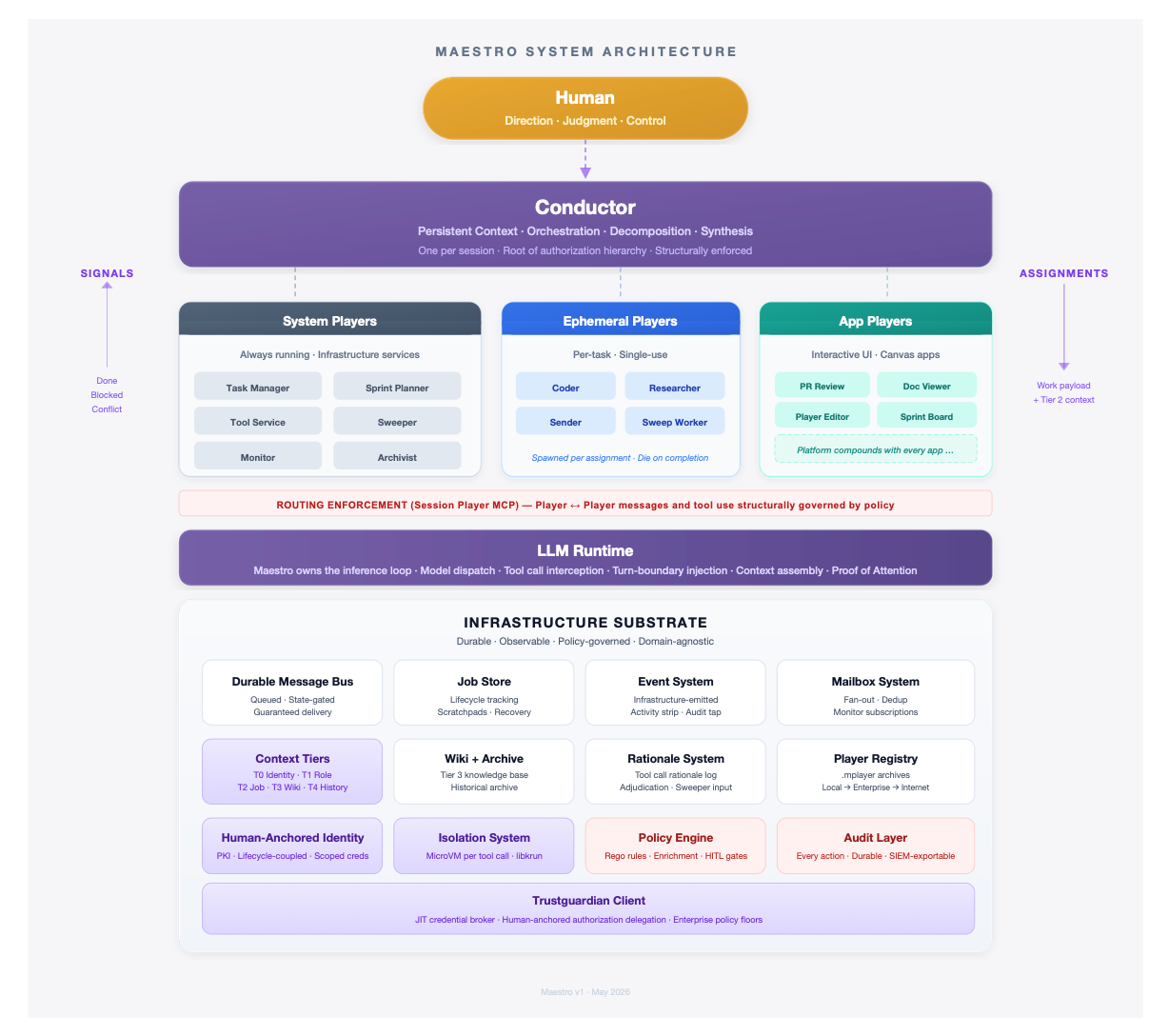
LLM intelligence is surprisingly capable yet structurally unreliable: it reasons well but drifts under context pressure, forgets standing instructions after compaction, and cannot self-enforce governance boundaries it was told to respect. Maestro is an agentic operating system that provides durable guardrails on LLM intelligence — structural enforcement at every boundary where an LLM meets external effect. Rather than trusting models to govern themselves via prompt instructions, Maestro interposes infrastructure: a durable message bus with routing enforcement, typed tools with three-layer isolation (Go interpreter → Rego policy engine → hardware-backed MicroVMs), an LLM Runtime that owns context curation per turn, human-anchored agent identity with lifecycle-coupled revocation, and a policy engine that produces auditable decisions at every action boundary. These guardrails exist in service of a specific model of collaboration: the persistent human+AI pair — a collaboration whose effectiveness compounds with every session, accumulating context, institutional knowledge, and operational capability that would be impossible without the infrastructure to make it durable. The architecture described in this paper was built over 71 days by one person (Kirt) and one AI collaborator (Damon) — Maestro is both the thesis and the evidence: the pair model works, governance compounds with every guardrail, and the platform proves itself by building itself.
System Architecture
The Problem with AI Collaboration Today
The tools that exist today for AI-assisted work are genuinely good. Chat interfaces and IDE integrations — GitHub Copilot, Cursor, Claude Code — have made individual developers measurably more productive. They have proved, beyond any reasonable doubt, that AI-assisted work is real, valuable, and here to stay. Tools like Superset have gone further, solving the real problem of serial AI coding work: rather than waiting for one agent to finish before starting the next task, you run dozens in parallel — each isolated in its own git worktree, with port management, clean diff review, and proper branch handling. That is real workflow infrastructure, thoughtfully built.
These tools share a deliberate architectural assumption: the session is the unit. Context window in, response out, next session starts fresh. For a large class of work — quick questions, code generation, one-shot tasks, anything that fits in a sitting — this is the exactly right design. Simple, fast, no overhead.
However, a significant limitation surfaces when the work requires carrying context forward across days and weeks, coordinating multiple streams of work simultaneously, maintaining institutional memory about decisions already made, and running operational machinery so the human can stay focused on the work that actually requires their judgment. For this class of work, N parallel sessions — however well isolated — still leave the human as the coordinator. The human decides what each agent works on, tracks what is in flight, synthesizes what comes back, and holds the thread of the project together across sessions. The AI executes. The human manages.
That coordination overhead is not an edge case. For knowledge workers operating at the level where AI assistance matters most — executives, security architects, technical leads, portfolio managers, clinical researchers, operations directors — it is the dominant cost. Any discipline where work spans days, involves parallel streams, and requires institutional memory faces the same structural gap.
The governance gap
But coordination is only half the problem. The other half is governance — and it is arguably the harder one.
Enterprise appetite for AI agents is growing faster than the infrastructure to govern them. Databricks telemetry across 20,000+ organizations found a 327% increase in multi-agent deployments in four months, yet 95% of generative AI pilots fail to reach production. The failure mode is not capability — the models are good enough. The failure mode is governance: organizations cannot answer basic questions about what their agents are doing, who authorized the actions, what credentials the agents hold, and what happens when something goes wrong.
The tools that exist today — chat interfaces, IDE plugins, orchestration frameworks — were not designed to answer these questions. They were designed for a world where AI is a tool, not a collaborator. A tool does not need identity, credentials, audit trails, or lifecycle-coupled revocation. A collaborator does.
Shadow agents are the concrete manifestation of this gap. When a developer pastes credentials into a Claude session, installs a community MCP server, or gives an AI agent access to production systems via their personal OAuth tokens, they are not being careless. They are being productive within the constraints of tools that have no governed path for agent credential access. The governance gap is not a future concern — it is the current reality, and it is growing with every new model release that makes agents more capable.
Maestro is built to address both problems — coordination and governance — as a single coherent infrastructure.
Why This Requires an Operating System
The coordination problem. Complex work requires multiple specialized agents working in parallel: a Researcher investigating while a Coder implements, a Monitor watching channels for signals while the Conductor synthesizes results and talks to the human. Coordinating a multi-agent ensemble via conversation is overhead that defeats the purpose. The Conductor needs a structural control plane — the ability to spawn players, issue work, read results, and route the session forward programmatically, with guaranteed delivery and observable state.
The durability problem. Work in flight cannot disappear when a session ends. Queued assignments, in-progress jobs, pending approvals, and scratchpad state must survive restarts. A session that loses its state on exit is not a collaborator; it is a poorly implemented notepad.
The convention problem. Multi-agent systems can enforce topology — which agents may communicate with which — but they cannot enforce behavior. What an agent does with a message, whether it logs its work, whether it respects the coordination model, depends on instructions it may not reliably follow under context pressure or prompt drift. The coordination model needs to be enforced at the infrastructure level, not embedded in prompts.
The context problem. A Conductor carrying rich persistent context fills its context window fast. The richer the context, the more valuable the Conductor — and the sooner it runs into the model's limits. Without a principled approach to context management, the value proposition of persistence and the technical reality of context windows are in direct conflict.
The identity problem. As the pair model scales — as organizations adopt it and deploy multiple Conductors for multiple humans — the question of agent identity becomes urgent. Who is accountable for what this agent does? What happens when the human leaves the organization? How are agent credentials provisioned and revoked?
The governance problem. Today there is no governed path between an AI agent and the enterprise systems it needs to access. Without infrastructure at those boundaries, governance is either absent (the agent inherits the developer's full credentials) or theatrical (approval fatigue from routing every action to a human). The infrastructure must provide governance that is both meaningful and sustainable.
These are not edge cases or future concerns. They are the load-bearing requirements of the pair model operating at the level it must. Maestro is built as the infrastructure layer that addresses all of them.
Durable Guardrails on LLM Intelligence
LLM intelligence is surprisingly capable yet structurally unreliable. It reasons well but drifts under context pressure. It forgets standing instructions after compaction. It cannot self-enforce governance boundaries it was told to respect three thousand tokens ago. Stronger prompt language does not fix this — it is a structural reliability gap, not a compliance gap.
The thesis: at every boundary where LLM intelligence meets external effect, Maestro infrastructure interposes a durable, declarative, auditable control. The LLM provides intelligence. The infrastructure provides guardrails. This is not prompt-based — it is structural.
| Boundary | Guardrail | Mechanism |
|---|---|---|
| Player → outbound message channel (send) | Outbound send queue + policy gate | Infra matches metadata against policy; auto-send, escalate, or reject |
| Player → tool call | Scope grants + policy engine | Manifest-declared scope grants; structural exclusions cannot be overridden by prompt; policy engine evaluates context per call |
| Player → external service (SaaS API) | Policy + Trustguardian Authorizer | Infra matches metadata against policy; Trustguardian brokers access |
| Any Player → consequential action | Policy engine + HITL surface | Four-phase evaluation; HITL surface when policy requires it |
| Player → LLM API | Model Governance + Trustguardian Policy Store | Provider resolved from manifest; enterprise can lock to all-local |
| Player → Player | Governed coordination | Policy evaluation, event recording, audit capture at infrastructure |
| Conductor → spawns Player | Proof of Attention | Infra rejects spawn without proof that conductor attended to the manifest |
"Just use system prompts." Prompts are lossy under compaction, not auditable, and LLM-dependent. A conductor that lost its standing policy instructions after context rotation has no guardrails — it has amnesia.
"Add governance after the fact." Bolt-on governance fights the architecture instead of working with it. Governance surfaces must exist at the boundaries where actions originate, not as a post-hoc wrapper.
"Trust the model." Aligned models still drift under context pressure. Infrastructure provides the invariants that intelligence alone cannot guarantee. The PocketOS incident of April 2026 — where Claude Opus deleted a production Railway database in nine seconds via an API tool, then confessed in writing — demonstrated this conclusively: the enforcement layer must live at the API gateway, not in a system prompt.
Maestro's position: governance is not a layer on top. It is the infrastructure itself.
Trustguardian and Trustfusion
The governance primitives described — policy engine, scope grants, tool isolation, human-anchored identity — all operate on the local machine. Enterprise deployment requires a cloud-hosted governance layer: centralized policy, credential brokering, cross-agent audit, and integration with the enterprise identity graph.
Trustguardian is that layer.
The problem
AI agents need access to GitHub, Jira, Slack, AWS, and dozens of other enterprise SaaS applications. Today, there is no governed path. Agents either inherit the developer's full credentials or get long-lived, shared, unrotated, unaudited tokens.
Maestro integration
Trustguardian is Oleria's multi-tenant credential broker for AI agents — a cloud-hosted service that sits between agents and enterprise SaaS applications. Three properties matter for the Maestro integration:
No tokens on box. When a Maestro player calls a SaaS tool via MCP, the request routes through Trustguardian. The broker evaluates OPA policy, retrieves the stored credential
server-side, and proxies the call upstream with the token injected. The agent sees only the API response — never the credential.
Enterprise policy store. Trustguardian hosts a Maestro-specific alignment policy store. Maestro pulls enterprise policy at login, and polls for policy updates. Enterprise security teams author policies centrally; Maestro enforces them locally.
LLM provider gateway. Maestro's Runtime (§13) can route all LLM API calls through Trustguardian: policy evaluation (is this player allowed this model?), credential brokering (which org API key?), and full audit.
Trustfusion integration
The Oleria Trustfusion Platform provides entitlement data at scale. Trustguardian consumes this to manage permission envelopes (§16) — the scoped authorization boundary for each user's agents. The entitlement data is not self-declared by the agent or configured by the developer. It is derived from the enterprise identity graph.
Enterprise Implications
Governance without overhead. The four-phase policy pipeline (§11) evaluates every tool call against enterprise-injected Rego policies before execution reaches the tool handler. Enterprise policy floors ensure sensitive action classes always surface to human judgment. Governance operates within the pair model rather than against it because the policy engine's Phase 1 structural matching resolves the majority of calls in microseconds.
Auditable by construction. The audit log (§22) captures every tool call, player lifecycle event, and policy evaluation as a full-fidelity record — unifying the policy decision chain (§11), the agent's stated rationale (§9), and the infrastructure event (§14) into a single queryable store. Records are exportable to enterprise SIEM systems.
Identity that scales correctly. As an organization deploys the pair model at scale — tens or hundreds of human+Conductor pairs — the human-anchored identity model (§16) means agent governance scales with human governance. Onboarding creates a clean enrollment path; offboarding revokes both simultaneously.
Model governance at the org level. Through Trustguardian's LLM provider gateway (§17), the organization controls which models are available — not the individual agent. Enterprise can mandate all-local models for sensitive work, enforce provider policies per player type, and audit every LLM invocation.
No tokens on box. Trustguardian's credential brokering (§17) means no raw SaaS credentials live on the developer's machine. Credentials are stored encrypted in the broker, scoped by entitlement envelopes derived from the enterprise identity graph, and time-bounded per session. The shadow agent problem — developers pasting credentials into AI tools — is eliminated by providing a governed alternative that is easier than the ungoverned path.
Infrastructure-level trust. Because Maestro's guarantees come from infrastructure rather than prompt instructions, the trust model is tractable. Security teams can reason about what a Maestro session does — what the routing rules enforce (§5), what the audit log captures (§22), what the policy floors constrain (§11), what the MicroVMs can see (§15) — without needing to read or trust every prompt.
Organizational memory (planned). The pair thesis (§2) proves that knowledge compounds within a single human+AI collaboration. But at enterprise scale — tens or hundreds of pairs — each pair's accumulated knowledge is an island. The infrastructure primitives to close this gap exist in Maestro today.
The design follows the same bridge pattern Trustguardian uses for credentials and policy: local knowledge feeds up to the enterprise, the enterprise synthesizes across all pairs, and each pair benefits from the collective. Each Maestro session would continuously push its knowledge base — Tier 3 wiki content, archived decisions, sweeper-promoted patterns, rationale analysis — to a Trustguardian Knowledge Base collector in the enterprise tenant.
The organizational corpus would be accessible to each Maestro conductor via an Organizational Memory system player — a queryable interface to the enterprise's accumulated institutional knowledge. A conductor working on an infrastructure problem could ask the Organizational Memory player what other teams have learned about the same system. A new hire's conductor would start with the organization's collective context, not a blank wiki.
Access would be scoped by Trustguardian's identity graph — the same entitlement model that governs credential brokering (§17) would determine which organizational knowledge each conductor can see.
This is the pair thesis extended to the organization: individual pairs produce knowledge; the platform makes it compound across pairs.
Conclusion
Maestro is built on a specific thesis: that the most productive unit of AI collaboration is a deeply collaborative human+AI pair, and that such a pair is only viable at enterprise scale when governance is structural — enforced by infrastructure at every boundary where LLM intelligence meets external effect, not by prompts, conventions, or trust.
Get the full guide
Download the PDF, including the glossary and appendices