What's new in Oleria: governing every identity, from discovery to runtime
Oleria now governs every identity that can act in your business, from discovery to action. Today we extended the platform to non-human identities and AI agents, launched the Oleria AI Gateway for runtime control, and released a product that reasons over identity context.

Key takeaways
- Oleria governs human, non-human and AI agent identities on one platform, from discovery to runtime.
- Oleria finds AI agents across Entra, Copilot Studio, Bedrock, Agentforce, Databricks and ChatGPT, then gives each one a human owner.
- The Oleria AI Gateway controls agent actions at runtime over MCP and REST. It keeps credentials away from agents and logs every decision.
- Every service account, API key and machine credential gets a named owner. When someone leaves, the credentials they owned are reassigned.
- Oleria AI answers identity questions in plain language and lets teams act from the same screen.
This summary was created with AI and reviewed by an editor.


Featured event: a CISO’s take
Join Jim Alkove and Ramy Houssaini to learn how forward-thinking security teams are addressing Enterprise AI Copilot risks.
Why delegation comes first
Every enterprise is racing toward AI that acts on its own. Autonomy requires a strong foundation. Delegation defines what we handed the agent and through whom it acts.
An AI agent never acts alone. It acts for a person, through a service account, API key or OAuth token, on your data. Some agents hold an identity of their own. Many share one service account with dozens of other agents. Others borrow a person's authority outright. Govern only the agent and you miss most of what it can reach.
That is why Oleria governs the whole chain, on one platform, from one understanding of access:
- The human who is accountable for the agent
- The AI agent and the platform it runs on
- The non-human credential it acts through
- The data it can reach, down to each permission on each resource
Governance and security work from the same graph. When they run separately, each is blind to what the other sees.
AI agents: from discovery to every action
Oleria finds the AI agents running in your environment. It gives each agent an owner, shows reachable data, and controls runtime actions.
- Discover. Find AI agents and AI tools across SaaS and cloud, including Microsoft Entra, Copilot Studio, Amazon Bedrock, Google Cloud, Agentforce, Databricks and ChatGPT. For each agent, see its permissions, its activity and the human accounts it is linked to.
- Own. Every agent gets a human owner who answers for its access. When that owner leaves, the agent goes to a reviewer to name a new one, so no agent keeps access after its creator is gone.
- Size the blast radius. See every account an agent acts through and which credentials its tools use, tied back to the human access it borrows.
- Review. Owners review agent access alongside the people and service accounts they already certify.
Runtime AI governance with the Oleria AI Gateway
Agents act in milliseconds, so governing static access grants is insufficient. The Oleria AI Gateway sits between agents and enterprise systems, evaluating every call over MCP and REST as it happens.
- Agents never hold the keys. The Gateway brokers credentials: user OAuth, machine-to-machine client credentials, your own OAuth apps and API-key apps. Secrets stay in the Gateway, isolated per tenant under their own encryption keys, and never reach the agent or its prompt.
- Policy on each action. Allow, deny or require approval for specific actions and arguments. Opening a pull request is allowed. Transferring repository ownership needs approval. Deleting a repository is denied.
- Policy as code. Write policies in Open Policy Agent, with built-in data loss prevention.
- A human in the loop. Route risky actions to an approver, and grant just-in-time, time-bound access when it is needed.
- A record of every action. Each entry captures the agent, the action, its arguments, the app and the decision: allowed, blocked or sent for approval.
- No change for developers. The Gateway works without changing how developers build or how agents run.
Non-human identities: every credential, a named owner
Service accounts, API keys and OAuth apps far outnumber people, and they are what AI agents run on. Most have no owner and no review. Oleria finds them, assigns an owner and fixes what is wrong.
- Discover. Service accounts, API keys, OAuth app authorizations, service principals and machine credentials across SaaS, cloud and on-premises systems, including ones nobody registered. See what each can access, at what privilege, and when it was last active. New identities appear as soon as they are detected.
- Own, automatically. Oleria validates and ranks ownership signals and creator data to assign a named owner to each non-human identity, with a review queue for corrections. Every assignment records who assigned it, on what signal and when.
- No orphans when people leave. When an owner leaves or changes teams, their non-human identities are surfaced for reassignment at that moment, when ownership gaps usually open.
- Fix it where you find it. Dormant, over-privileged and ownerless credentials and secrets that were never rotated are surfaced with their owner attached. Revoke, disable or roll back through live write-back to the source system, so each change is confirmed at the source.
- Certify together. People and non-human identities share one access graph, so a single certification covers a manager's team and the credentials that team owns.
Human identities: access based on what people actually use
Employees, contractors and partners get the access they need, and lose what they stop using, with every decision grounded in real activity.
- Usage-aware access reviews. Reviewers see real activity, peer comparisons and risk for every entitlement, so "just in case" access gets removed, with remediation built into the review.
- Group reviews. See who belongs to each group, who is dormant and who should be removed, so inherited and nested permissions don't outlive their purpose.
- Joiners, movers and leavers. Access is recommended and adjusted from role, usage patterns and policy as people join, change roles or leave.
- Self-service access requests. People request and track access in one place, see the risk before approval, and get time-boxed access for resources their peers rarely keep.
- Just-in-time access and zero standing privileges. Elevated access is granted for a task and removed after it, so admin rights don't sit unused.
- Continuous compliance. Audit evidence for reviews, access rights and policy adherence is gathered as it happens, ready for SOC 2, ISO 27001, HIPAA and SOX.
Secure every identity: hygiene, exposure and response
Governance decides who and what should have access. Security shows what is exposed and what each identity is doing. Oleria runs both on the same graph.
- Identity hygiene. Close the gaps attackers look for first: missing MFA, accounts outside SSO, local and admin accounts nobody manages centrally, and dormant or over-privileged access. Disable or right-size in place, and roll back anything disabled in error.
- Exposure management. Configuration, authentication, MFA and privilege issues across every system in one view, scored against NIST CSF and CIS, so teams can prioritize the work and report progress.
- External access and sensitive data. See what is shared outside the organization, find anonymous links and oversharing, and see who can reach data labeled highly confidential.
- Shadow AI and shadow IT. Find AI tools, agents and SaaS accounts in use without security's knowledge, and the data they were given.
- Investigate. When a compromise is suspected, see who accessed the data, how they got access and what they did, for any person, credential or agent, without stitching logs together by hand.
- Contain. Revoke access, disable accounts and roll back changes with containment playbooks built in Workflow Studio.
A product that reasons, then acts
We rebuilt Oleria around one idea: operators should get answers, and act on them in the same place. Every answer draws on a graph that runs from each person or agent, through every account and role, down to the individual permission on each resource, with what is granted and what is actually used.
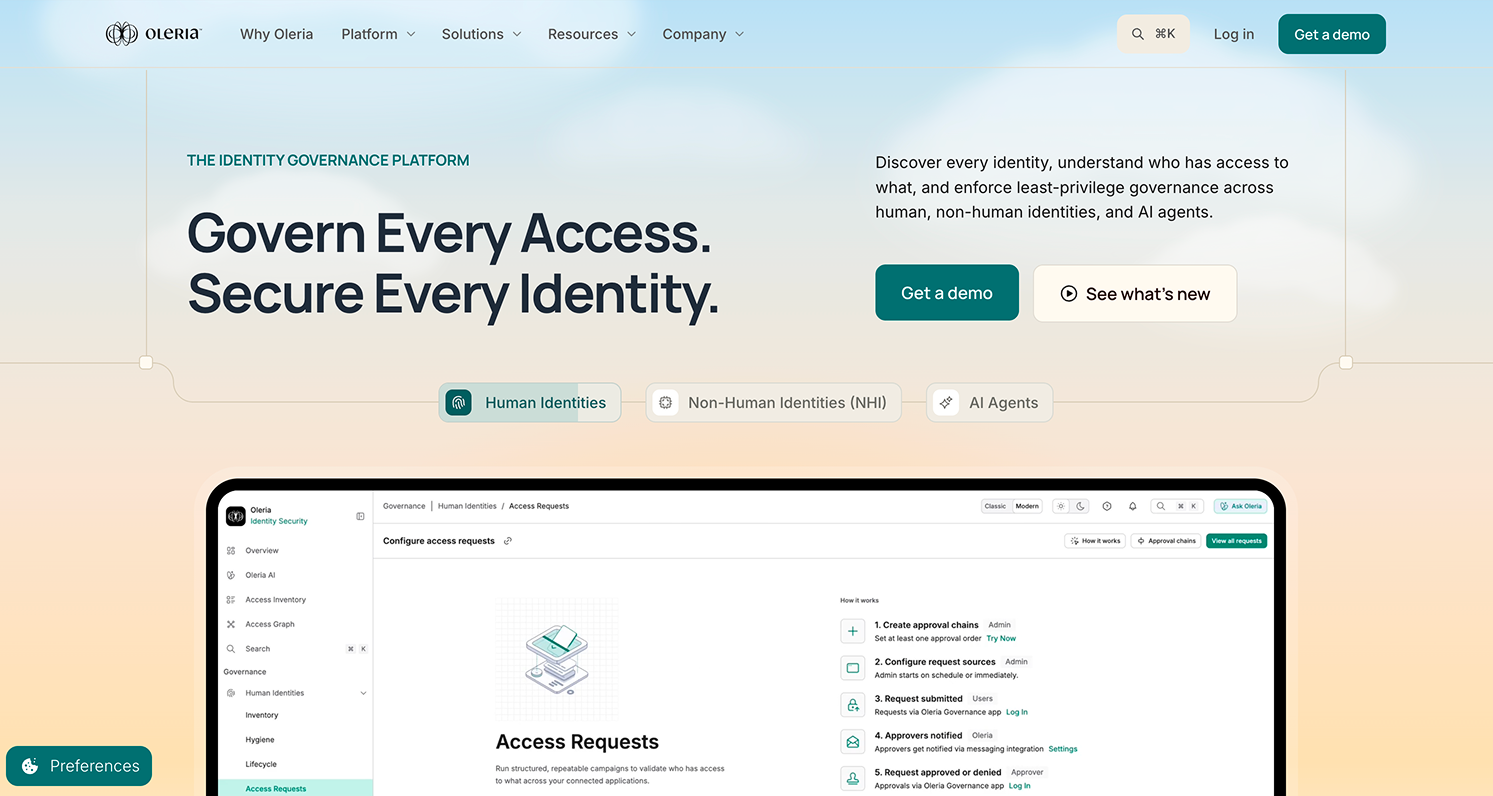
- Ask and get evidence. Oleria AI answers identity questions in plain language, such as which accounts quietly picked up admin rights or what one compromised credential could reach. Every recommendation shows its reasoning: the peer group, the usage and the risk factors.
- Act where you look. Revoke access, open a ticket or route an approval from the same screen. Each workflow runs as hands-on or hands-off as the team chooses: notify, ticket, or remediate automatically.
- Workflow Studio. Describe a condition in plain language, such as a service account idle for 90 days or an admin role granted outside business hours, and get a workflow that runs on a schedule or the moment the condition is met.
- Query Studio. Plain English becomes a query against your identity graph. Every generated query is visible and editable before it runs, and follow-up questions refine it.
- Integration Studio. Bring internal platforms, custom apps and AI services into Oleria with connectors built by AI, governed like everything else.
- Oleria MCP. Ask about access, ownership or risk from Claude, ChatGPT, Cursor or Claude Code. Access is read-only, bound to what each person can already see, and every query is audited.
In production today
Since the March launch of Adaptive Identity Governance, Oleria governs over 7.1 million human, non-human, and AI agent identities across customer environments. The platform processes 52 billion identity events and evaluates more than 1.2 billion graph relationships across more than 400 applications. Oleria AI answers complex security and compliance queries hundreds of times each month, while security teams build custom connectors using Integration Studio to secure every access path.
Frequently asked questions
What did Oleria announce on November 18, 2026?
Oleria extended its identity governance platform to non-human identities and AI agents, launched the Oleria AI Gateway for runtime control of agent actions, and released a redesigned product that reasons over identity context. Human, non-human and AI agent identities are now discovered, owned, governed and secured on one platform.
Why can't AI agents be governed on their own?
An AI agent acts for a person, through a non-human credential such as a service account or API key, on data. Governing the agent alone misses access it borrows through that person or credential. Oleria governs the whole chain, so its view of an agent's reach includes delegated access.
What does the Oleria AI Gateway do?
The Oleria AI Gateway sits between AI agents and enterprise systems over MCP and REST. It brokers credentials so agents never hold them, allows, denies or routes each action for approval based on policy written in Open Policy Agent, and records every action with its decision.
How does Oleria assign owners to non-human identities?
Oleria validates and ranks ownership signals and creator data to assign a named human owner to each service account, API key and machine credential, with a review queue for corrections. When an owner leaves, their non-human identities are surfaced for reassignment immediately.
Does Oleria replace Okta or Microsoft Entra ID?
No. Oleria works alongside identity providers such as Okta and Microsoft Entra ID, plus cloud, SaaS, on-premises and AI agent platforms. It adds one governance and security layer across all of them, connecting read-only by default.
Does Oleria make changes automatically?
Only when you choose. Oleria connects read-only by default. Teams turn on remediation per integration and decide which workflows notify, open a ticket or remediate automatically.
What is an AI agent's blast radius?
An AI agent's blast radius is everything it could reach if it misbehaved or were compromised: its own permissions plus access delegated from the person, agent or tool that invoked it. Oleria calculates it from real entitlements and usage, so teams can reduce an agent's reach before an incident.
How fast does Oleria deliver results?
Oleria connects read-only and delivers first findings within hours. Teams see their human, non-human and AI agent identities, unused access and exposure before turning on any remediation.
Availability and next steps
The expanded platform is available today to all Oleria customers, with no action required. Existing integrations, reviews and workflows carry over.
- See it live. Request a demo.
- Meet us at Gartner IAM. Oleria will demonstrate the platform at the Gartner Identity & Access Management Summit, December 7 to 9 in Las Vegas.
- Read the announcement.