What Is IVIP? Identity Visibility and Intelligence Platforms Explained
Most enterprises cannot answer who has access to what sensitive data because their identity tools each cover one domain without sharing a common access graph. An IVIP fixes that by correlating human users, non-human identities, and AI agents across every connected system into a single continuously updated intelligence layer.

Key Takeaways
- Most enterprises cannot answer who has access to sensitive data right now because identity tools like SSO, PAM, CIEM, and IGA each cover one domain but share no common access graph, leaving security teams to manually reconcile CSVs across systems that never talk to each other.
- An IVIP operates across three layers: a State Layer that inventories every human, NHI, and AI agent identity; a Topology Layer that maps nested groups, role chains, and cross-account trusts into an effective permissions graph; and a Behavior Layer that correlates runtime activity to flag dormant access, entitlement drift, and blast radius.
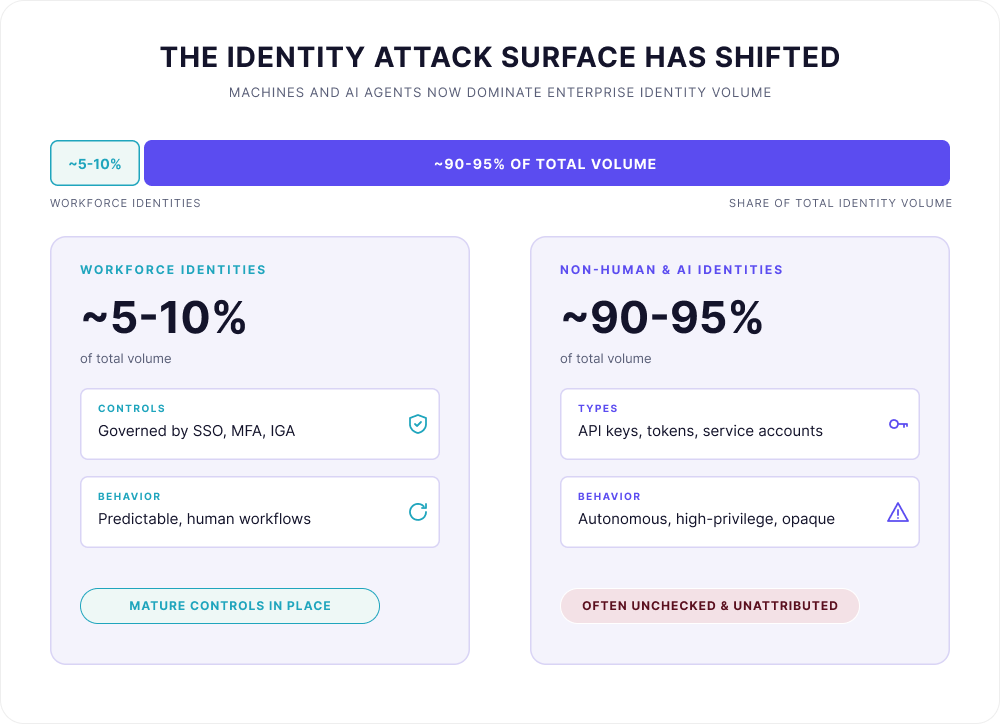
- Non-human identities now represent 90 to 95 percent of total identity volume in modern enterprises, yet most governance programs were built for the 5 to 10 percent that are human, leaving API keys, service accounts, and AI agent delegations ungoverned by default.
- Oleria’s Trustfusion platform implements the IVIP model with agentless API connectors, an automatically reconstructed enterprise identity graph, and closed-loop remediation that goes beyond passive dashboards to revoke access, right-size permissions, and trigger adaptive governance reviews in real time.
This summary was created with AI and reviewed by an editor.

Ask AI to write a summary


Featured event: A CISO’s take
Join Jim Alkove and Ramy Houssaini to learn how forward-thinking security teams are addressing Enterprise AI Copilot risks.
What is an Identity Visibility and Intelligence Platform (IVIP)?
An Identity Visibility and Intelligence Platform (IVIP) is an enterprise cybersecurity software category that aggregates, correlates, and continuously analyzes fragmented identity data across hybrid enterprise environments. Functioning as a real-time analytics and relationship layer across directories, multi-cloud platforms, SaaS suites, and legacy IAM systems, an IVIP unifies visibility across human users, non-human identities (NHIs), and autonomous AI agents without replacing underlying identity systems of record.
Ask any Chief Information Security Officer (CISO) or Identity and Access Management (IAM) lead a seemingly basic operational question:
“Who has access to our sensitive customer data right now, how did they get that access, and what have they actually done with it over the past 30 days?”
In most enterprise environments, answering that question takes weeks of cross-team coordination. An engineer must pull CSVs from an Identity Governance and Administration (IGA) tool, query Active Directory or Entra ID, inspect role policies across AWS, Azure, and Google Cloud, pull OAuth grant logs from SaaS platforms, and reconcile everything against a spreadsheet left over from last quarter’s compliance audit.
Enterprises are not lacking identity tools. In fact, most teams have an overabundance of them: Single Sign-On (SSO), Privileged Access Management (PAM), Cloud Infrastructure Entitlement Management (CIEM), and Identity Threat Detection and Response (ITDR).
What teams lack is contextual coherence.
Recognizing this architectural blind spot, Gartner introduced the Identity Visibility and Intelligence Platform (IVIP) category (formalized in research authored by Rebecca Archambault and Nathan Harris). At Oleria, where our mission has always centered on delivering adaptive identity security, we view the introduction of IVIP as a fundamental transition in how organizations manage trust.
This guide provides a comprehensive breakdown of what an IVIP is, its architectural layers, how it compares to legacy tooling, and how it addresses non-human and AI identity risk.
The identity blind spot: why modern stacks fractured
Enterprise access architecture was originally designed for a perimeter that no longer exists:

Four fundamental shifts broke the legacy approach:
- Explosive SaaS and Multi-Cloud Adoption: Permissions are no longer centralized in directory groups; they are defined independently within disparate APIs across hundreds of cloud applications.
- The Rise of Non-Human Identities (NHIs): API keys, service accounts, serverless functions, and machine tokens now outnumber human users by an average ratio of 10:1 or more. Many run unchecked with indefinite lifespans and zero attribution.
- Autonomous AI Agents & Copilots: Generative AI tools and Model Context Protocol (MCP) agents autonomously query internal databases, assume delegated roles, and invoke external APIs on behalf of users—creating complex webs of transitive privilege.
- Data Silos in the Security Stack: Point solutions produce isolated alerts without sharing an underlying access graph. CIEM monitors cloud infrastructure; PAM vaults administrative credentials; IGA schedules compliance certifications. None of them answer the compound access question across domains.
An IVIP solves this problem not by serving as another identity provider or forcing organizations into a painful "rip-and-replace" project, but by acting as a read-intensive, cross-domain intelligence substrate.
Technical architecture: the three-layer IVIP model
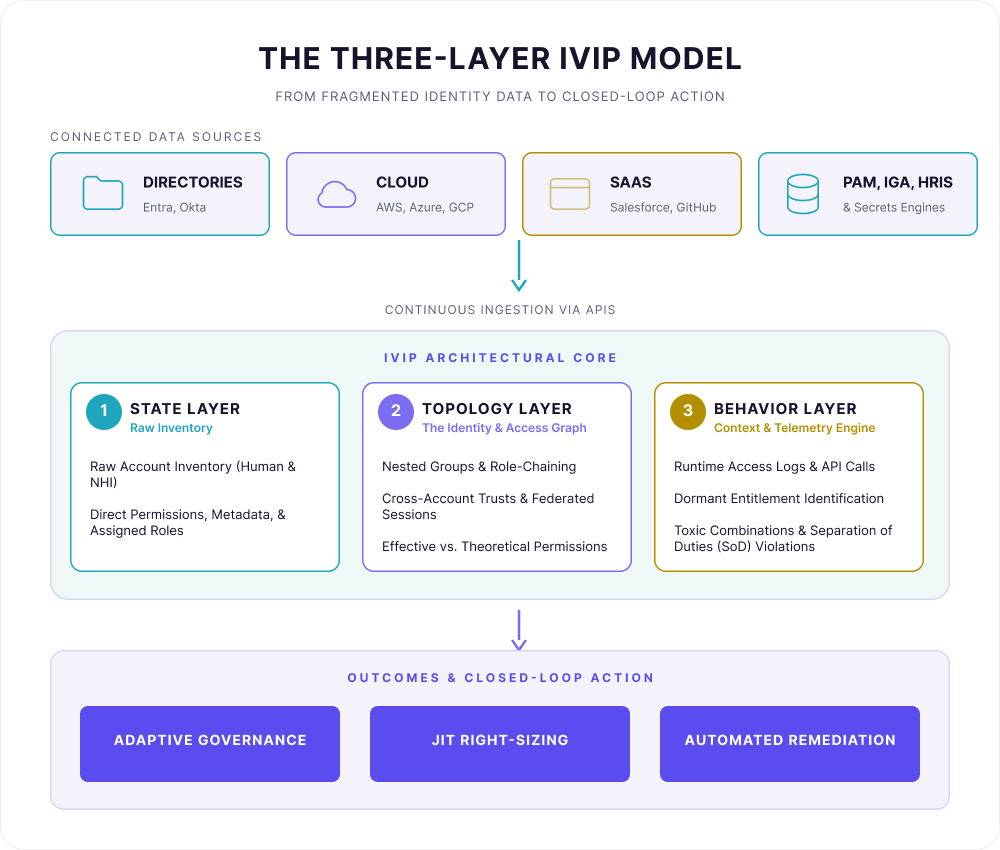
To translate millions of disconnected identity objects into clear risk intelligence, a modern IVIP operates across three distinct architectural layers:
1. The state layer (Raw inventory)
The State Layer establishes a baseline of your entire environment through agentless, API-first connectors:
- Catalogs every identity object across workforce directories, developer hubs, and cloud estates.
- Normalizes metadata such as account creation dates, custodianship, department affiliation, and assigned roles.
- Accounts for unmanaged identities, including external guest accounts and orphan service tokens.
2. The topology layer (The access graph)
Permissions are almost never direct in modern environments; they are chained. The Topology Layer builds a Unified Access Graph to map how entitlements flow:
- Nested Groups: A user in an engineering distribution group inherits an SSO profile that grants an AWS IAM role, which in turn permits cross-account access to customer data.
- Effective Permissions: Decouples what an administrator thought was granted from what an identity can actually execute across targeted resources.
- Transitive & Federated Trusts: Traces multi-cloud trust boundaries, third-party vendor connections, and OAuth application delegations.
3. The behavior layer (Usage & runtime intelligence)
Knowing that a permission exists does not reveal whether it is dangerous; runtime context does. The Behavior Layer correlates configuration states with actual audit and access logs:
- Dormant Access Discovery: Flags credentials or high-privilege tokens that have gone unused for 60, 90, or 180 days.
- Entitlement Purpose Drift: Identifies when an employee changes functional roles, yet retains high-risk administrative access to systems they no longer touch.
- Blast Radius Analysis: Computes the potential systemic exposure if a specific account, token, or API key were compromised.
IVIP vs. adjacent technologies: defining the ecosystem
Because IVIP sits at the intersection of several cybersecurity domains, it is critical to understand how it differs from and complements existing tools.
IVIP vs. ISPM: posture vs. complete context
ISPM solutions are designed to find posture flaws—such as accounts missing multi-factor authentication (MFA) or outdated password policies. An IVIP incorporates these posture metrics, but combines them with multi-cloud topology and behavioral telemetry. An IVIP answers not just "Is this setting misconfigured?" but "Does this misconfiguration enable an exploitable lateral movement path right now?"
IVIP vs. IGA: From periodic rubber-stamping to continuous governance
Legacy IGA platforms require quarterly access certifications where managers review rows of obscure entitlements they do not understand, leading to pervasive rubber-stamping. An IVIP transforms this process into Adaptive Identity Governance, enriching reviews with plain-language context, peer-group comparisons, and usage analytics showing whether the user actually utilized the permission.
The new frontier: securing Non-Human Identities (NHI) and AI Agents
The enterprise attack surface has shifted decisively toward machines and software agents. In modern cloud breaches, attackers rarely compromise human endpoints with malware; instead, they hijack unrotated API tokens, abuse over-permissioned service accounts, or exploit broad cloud roles.
Modern IVIP solutions specifically address non-human and AI identity exposure:
- Custodianship Attribution: Automatically connects orphaned machine accounts back to a human owner, software repository, or responsible team.
- AI Agent Tool-Execution Tracking: Maps the boundaries of autonomous agents (such as Microsoft 365 Copilot or bespoke MCP agents), ensuring that transitive permissions granted to an agent cannot be abused to access restricted data stores.
- Automated Hygiene: Continuously surfaces unused API tokens, unrotated credentials, and dormant service accounts, making zero trust practical across machine layers.
The Oleria Perspective: Turning Visibility into Action
Gartner’s formalization of the IVIP category represents a major industry milestone. It validates what modern security practitioners have felt for years: building more perimeter walls or deploying isolated IAM point tools cannot protect a modern, interconnected enterprise.
At Oleria, we believe true security requires moving beyond passive dashboards. Visibility without execution leaves security teams with nothing more than an expensive inventory.
An effective IVIP must deliver on three operational pillars:
1. Comprehensive Graphing via Oleria Trustfusion
Rather than relying on tedious manual policy definitions, Oleria’s Trustfusion architecture automatically reconstructs the entire enterprise identity topology. It dynamically connects human users, SaaS permissions, non-human identities, and multi-cloud entitlements into a single, cohesive graph.
2. Rapid Time-to-Value with Native Integration
Enterprises cannot wait twelve months for a professional services team to write custom connectors. An IVIP must feature zero-friction, API-driven connectivity that brings SaaS, cloud, and directory environments into unified visibility within hours of deployment.
3. Closed-Loop Adaptive Action
True intelligence is actionable. When an IVIP surfaces a toxic combination of permissions, an over-privileged service account, or an offboarded employee whose OAuth tokens remain active, it must enable immediate response. Whether through automated remediation, one-click access revocation, or context-rich adaptive governance reviews, security teams can close risks immediately.
Frequently Asked Questions (FAQ)
What does IVIP stand for?
IVIP stands for Identity Visibility and Intelligence Platform. It is an enterprise cybersecurity software category defined by industry analysts, including Gartner, that collects, normalizes, and contextualizes identity data across hybrid enterprise environments.
Is an IVIP intended to replace existing IAM solutions?
No. An IVIP does not replace identity providers (such as Okta, Ping, or Microsoft Entra ID), PAM vaults, or core IGA directories. Instead, it serves as an intelligence substrate that reads data from these systems, correlates permissions with actual behavior, and provides the context required to enforce least privilege.
How does an IVIP differ from CIEM (Cloud Infrastructure Entitlement Management)?
CIEM tools focus specifically on permissions within public cloud providers like AWS, Azure, and Google Cloud. However, modern enterprise identities cross cloud boundaries into hundreds of SaaS tools, local active directories, and developer repositories. An IVIP provides end-to-end, cross-domain visibility, connecting a user’s corporate identity to both their cloud role and their SaaS application privileges.
How does an IVIP help secure autonomous AI agents?
Autonomous AI agents and LLM-powered enterprise assistants often operate using delegated permissions, allowing them to access corporate documents, invoke code, or query production data. An IVIP tracks agent identity contexts, evaluates their effective blast radius, and ensures that autonomous agents do not operate with unchecked, standing administrative access.
What are the key capabilities to look for when evaluating an IVIP?
When selecting an IVIP vendor, evaluate:
- Identity Scope: Does it cover human users, non-human identities (tokens, service accounts), and AI agents equally?
- Behavioral Correlation: Can it merge static role assignments with active runtime event logs to show actual vs. granted access?
- Time-to-Value: Does it integrate via agentless APIs with out-of-the-box connectors, or does it require professional services?
- Actionable Remediation: Can the platform initiate access right-sizing and automate governance workflows directly?
Ready to see what an Identity Visibility and Intelligence Platform looks like in practice? Explore the Oleria Trustfusion Platform or schedule a personalized demo with our security architecture team.
MITRE ATT&CK® v20 and AI agents: Start with the detections, not the techniques

Heading