Maestro

AI agents that can't go off the rails.

Maestro is the operating system your AI agents run on. It enforces guardrails in the infrastructure beneath the model, not in the prompt above it, so an agent cannot exceed the limits you set even when it is jailbroken, injected, or simply wrong.

Diagram showing human input managed by conductor to durable message bus linking system, ephemeral, and user players.splashDiagram showing human input managed by conductor to durable message bus linking system, ephemeral, and user players.
327%
YoY growth in multi-agent deployments.
Gartner, 2026
95%
of generative AI pilots never reach production.
MIT, 2025
The gap is governance, not capability.
Can you prove what your agents did?
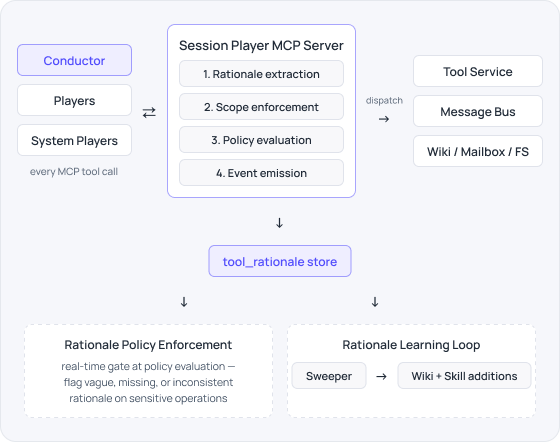
Flowchart showing Session Player MCP Server handling rationale extraction, policy evaluation, and dispatch to services.

Autonomy outran the guardrails.

Maestro turns ungoverned agent access into brokered, policy-controlled, fully-audited access — without changing how your developers or agents work. It governs OAuth apps, non-OAuth apps, and LLMs, over both MCP and REST.

‍

From asking the model to behave, to making misbehavior impossible:

Capability Before Maestro After Maestro
Guardrails Policies live in the prompt. A jailbreak, an injection, or a hallucination walks right past them. Policies live in the infrastructure beneath the model and hold even when the agent is fooled.
Tool access One “run anything” tool hands over the whole machine; a single bad call is unbounded. A typed tool surface, scoped per agent, and policy checked on every call.
Containment Agents share a host or container; one escape is full host access. Every tool call runs in its own hardware-backed microVM - created per call, network-isolated by default, and able to see only the files explicitly mounted into it. The blast radius is bounded by a hypervisor boundary, not by trusting the agent to behave.
Authorization Access is all-or-nothing, decided once at login. Actions are judged in the moment: allow, route to a human, escalate, or reject.
Identity Agent credentials outlive the people who created them and pile up as orphaned access. Each agent’s key is bound to a human’s existing SSO identity and revoked the moment that person leaves.
Audit The only record is what the agent reported about itself. A tamper-evident record of what the infrastructure did, with a rationale behind every action.
How Maestro works

Governance in the substrate, not the prompt.

Maestro sits between the agent and the machine, in the position of an OS kernel. Authority is granted and revoked structurally, and the model cannot widen its own boundaries because those boundaries were never in its reach. At every point where model intelligence meets real-world effect, Maestro interposes a durable, declarative, auditable control.

Diagram showing a policy evaluation pipeline with four phases and policy precedence levels and decision outcomes.Diagram showing a policy evaluation pipeline with four phases and policy precedence levels and decision outcomes.

Isolation at the granularity of a single tool call

Where most agent sandboxes isolate a whole session in one shared-kernel container, sandboxed code execution runs in its own hardware-backed microVM - created per call, network-isolated by default, and able to see only the files explicitly mounted into it. Egress isn't ambient; it's granted and brokered. The blast radius is bounded by a hypervisor boundary and least-privilege mounts, not by trusting the agent to behave.

Proof of attention

Before a conductor acts on a manifest or spawns a player, it must prove it read the content. The infrastructure embeds a cryptographic marker at a random position and rejects the action unless the returned hash matches. The only path to a valid hash is to attend to the desired content, so attention can't silently degrade over a long session.

Credential brokering

Governance you can turn on, not a platform you have to adopt.

Use the identity you already have.

Agents enroll once against your existing SSO. No new identity system to stand up, and no separate set of agent accounts to manage.

Runs where your agents already work.

Maestro runs on the device, on macOS, alongside the tools your teams use today. Agents don't move to a new platform to be governed.

Nothing to provision on the device.

Agents hold no standing secrets. The Oleria AI Agent Gateway brokers task-scoped access at runtime, so there are no keys to push out, rotate, or leak.

Set policy once, apply it everywhere.

Enterprise policy floors are defined centrally and applied as a non-overridable overlay. Local rules can tighten them but never weaken them.

One governed stack

Better together with the Oleria AI Agent Gateway.

Maestro governs the agent on the device where it runs. The Oleria AI Agent Gateway governs identity, credentials, model access, and policy at org scale. Delivered together as one stack, with one policy model and one audit plane, from device to enterprise.

Technical buyer? Ask your Oleria contact for the Maestro technical deep-dive, boundary by boundary.

AI Governance

Govern AI agents at the identity layer

Identity is the foundation of AI governance. Oleria provides a unified identity intelligence layer that gives you the visibility, control, and continuous governance needed to stay ahead of every AI agent in your environment.