
Incident Investigations
Investigate a Compromised Account Down to Every File
See what a compromised identity could reach, what it actually touched, and which sensitive data was involved, then contain it.
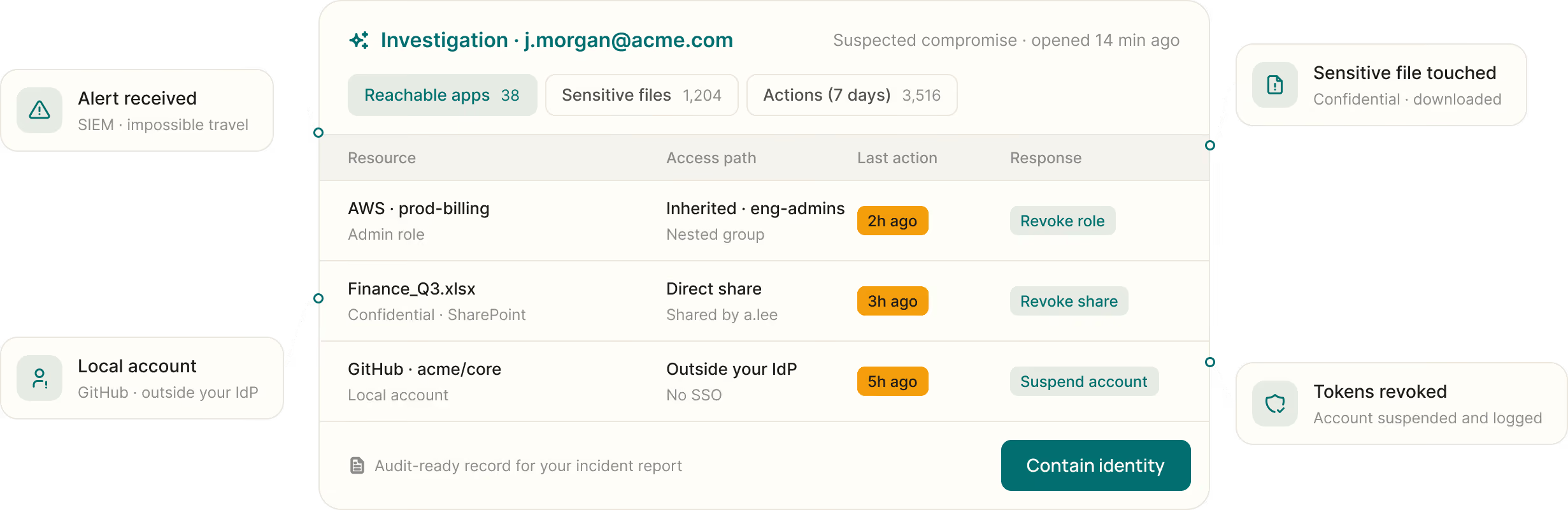
Stolen credentials stay hidden for months
An alert without scope
The alert names one account. Your SIEM can’t tell you what that account can reach.
Hidden access paths
Local accounts and shared links sit outside your IdP, and nested groups hide who really has access.
Unknown data exposure
No one can say quickly whether regulated or sensitive data was touched.
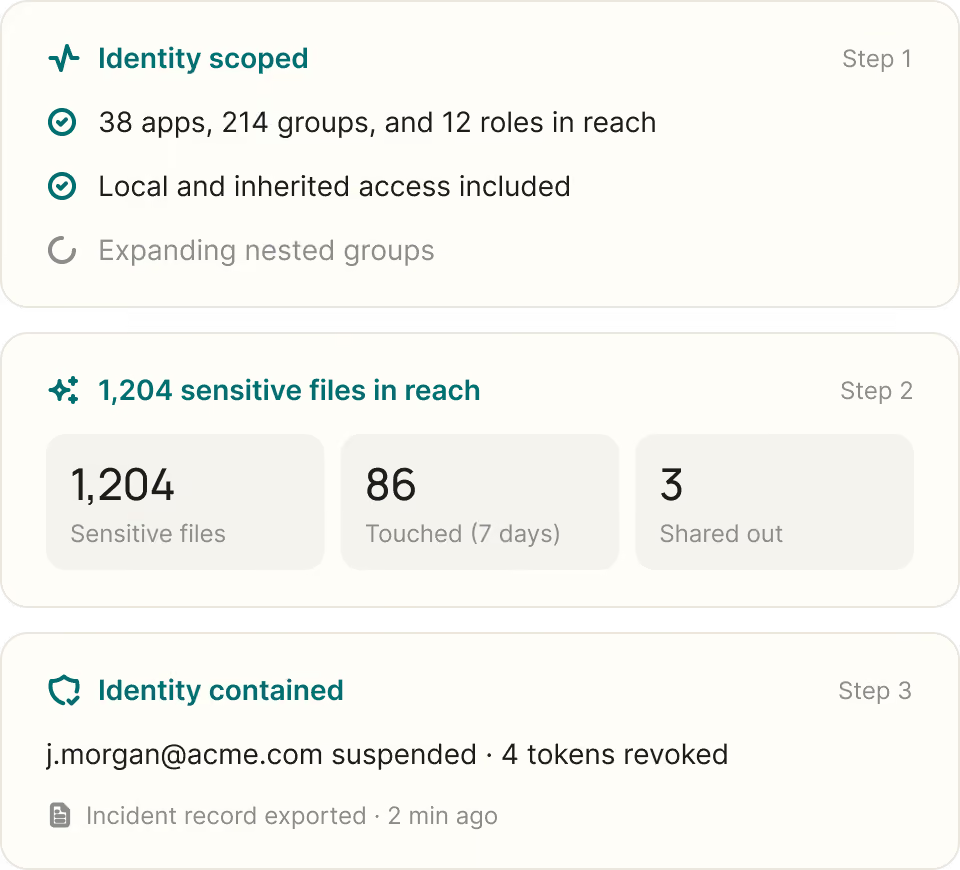

How an investigation runs in Oleria

Scope the identity. Search by name or email and see every app, group, role, and resource the identity can reach, including local and inherited access.

Trace what it touched. Review the identity’s create, read, update, delete, and share actions, with the sensitivity of every file involved.

Contain and report. Suspend the account, revoke tokens, or remove access, then export an audit-ready record for your incident report.
What identity investigations change for your team
For responders
Scope in One View Blast radius, activity, and data sensitivity together, not stitched from logs.
For security leaders
Clear Answers on Exposure Know whether regulated or confidential files were touched.
For IAM
Containment Without Switching Tools Suspend accounts, revoke tokens, or remove access from the investigation view.
For GRC
A Record for the Incident Report Access, activity, and response actions captured for your report.
Real customers. Real results.
Security teams use Oleria to clean up excess access, get through audits faster, and bring AI agents under control


Oleria is one of those things that once you see it and get it, it’s hard to imagine doing what you’ve been doing without it.


Being able to assess the current state and optimize around least privilege provides the ROI in itself. And the ability to understand what my engineers need will help us provide least-privilege access.


Oleria gives us unparalleled visibility into identity access and usage, saving time and strengthening our compliance posture.

Questions about incident investigations
What is an identity incident investigation?
An identity incident investigation works out what a suspected compromised account could access, what it actually did, and which data was affected, so the team can contain it and report on it. Oleria brings that access, activity, and data sensitivity into one view.
What is the blast radius of a compromised account?
Blast radius is everything a compromised identity can reach: apps, groups, roles, files, and the data inside them, including access inherited through nested groups. Oleria maps it across your connected systems so responders know the full scope before acting.
Can Oleria see access outside our IdP?
Yes. Oleria connects to the apps themselves, so it finds local accounts and app-level permissions that your identity provider does not show.
How does Oleria show which sensitive data was touched?
Activity on each resource is shown with its data sensitivity, so you can see whether an identity viewed, changed, downloaded, or shared regulated or confidential files.
Does this replace our SIEM?
No. Your SIEM detects the threat. Oleria adds the identity and access context behind the alert, so analysts can scope and contain the incident faster.
Learn more about incident investigations
Guides and customer stories on tracing what a compromised identity could reach, in minutes instead of days.