Quick summary: Self-service OAuth popups allow employees to bypass formal procurement and hook unvetted tools directly into corporate communication channels. Deploying Oleria Trustfusion, an AI-native identity security platform, introduces true identity security posture management to map this hidden landscape. This data-centric engine scans user consent repositories, cross-references active grants with employee privilege tiers, and isolates hidden integrations to ensure no unmanaged shadow applications retain access to corporate communication files.
Security and IT teams gain complete visibility into the shadow IT and unmanaged application landscape — every third-party application that has been granted access to corporate identity and data through OAuth, every employee who has authorized it, every scope that grant enables, and the risk it represents. Risky OAuth grants, over-scoped application permissions, grants held by privileged accounts, and grants that persist after employee offboarding are surfaced as prioritized posture findings and driven to revocation through structured campaigns.
This use case transforms shadow IT from an unquantified risk into a governed, continuously monitored part of the identity security program — making every OAuth grant as visible and accountable as any formally provisioned application integration.
Why shadow IT is an identity security problem: Every time an employee clicks "Authorize" on a third-party application using their corporate identity, they create an OAuth grant — a standing permission that gives that application access to their email, calendar, files, contacts, or other corporate data, for as long as the grant persists. Most organizations have hundreds or thousands of these grants across their workforce, the majority of which were never reviewed by IT, carry scopes far broader than the application needs, and remain active long after the employee stops using the application — or after the employee leaves the organization entirely.
Shadow IT exists precisely because it bypasses formal IT processes. The tools and processes designed to govern application access — IDP-managed provisioning, application catalogs, change management — were never designed to capture the OAuth grant landscape. Without a purpose-built platform, organizations face:
· OAuth grants are invisible to IDP-centric access governance. An OAuth grant is issued by an employee authorizing a third-party application directly — it does not go through the IT provisioning workflow, it is not recorded in the application catalog, and it is not visible in IDP admin consoles that focus on formally provisioned SSO integrations. The grant exists in the IDP's OAuth consent store, but this data is almost never surfaced in any access governance tool.
· The scope of exposure is systematically underestimated. A single OAuth grant may authorize a third-party application to read all email, access all calendar events, read and write all files, or manage contacts — using only the permissions the employee's own account holds. An employee with privileged access who authorizes a shadow IT application with broad scopes has effectively granted that application privileged access to corporate data. This compound risk is invisible without a platform that joins OAuth grant scope data with the granting identity's access profile.
· Grants persist indefinitely after use ends. OAuth grants do not expire automatically in most platforms. An application authorized once by an employee three years ago may still hold an active grant — with valid access to that employee's email and files — even if the employee has not opened the application since. The grant persists until explicitly revoked, which almost never happens without a systematic discovery and remediation process.
· Offboarding does not revoke OAuth grants on local accounts. When an employee is offboarded and their IDP account is deactivated, OAuth grants they made using local SaaS credentials — rather than IDP-federated accounts — may remain active. The third-party application retains a valid token that can continue to access data even after the employee's corporate account is disabled. This is the same offboarding gap that affects all local accounts, amplified by the potentially broad scope of the OAuth grant.
· No inventory of which applications have been granted access to corporate data. Without a platform that specifically ingests and analyzes OAuth consent data, organizations have no reliable inventory of which third-party applications hold active access to corporate identity and data. The shadow IT application population is unknown in size, unknown in scope, and unknown in risk — until a breach makes it visible.
· Privileged accounts granting OAuth access create compound risk. An executive or administrator who authorizes a third-party productivity application with broad email and file scopes has granted that application access to potentially sensitive corporate communications, financial data, and confidential documents. Without visibility into which privileged accounts have active OAuth grants and what scopes those grants enable, this compound risk is systematically undetected.
Oleria Trustfusion ingests OAuth grant data from connected identity providers and SaaS platforms, maps every grant to the identity that issued it, evaluates the risk of the grant based on scope, granting identity privilege, and grant age — and surfaces the shadow IT application landscape as a continuously maintained, risk-prioritized posture view.
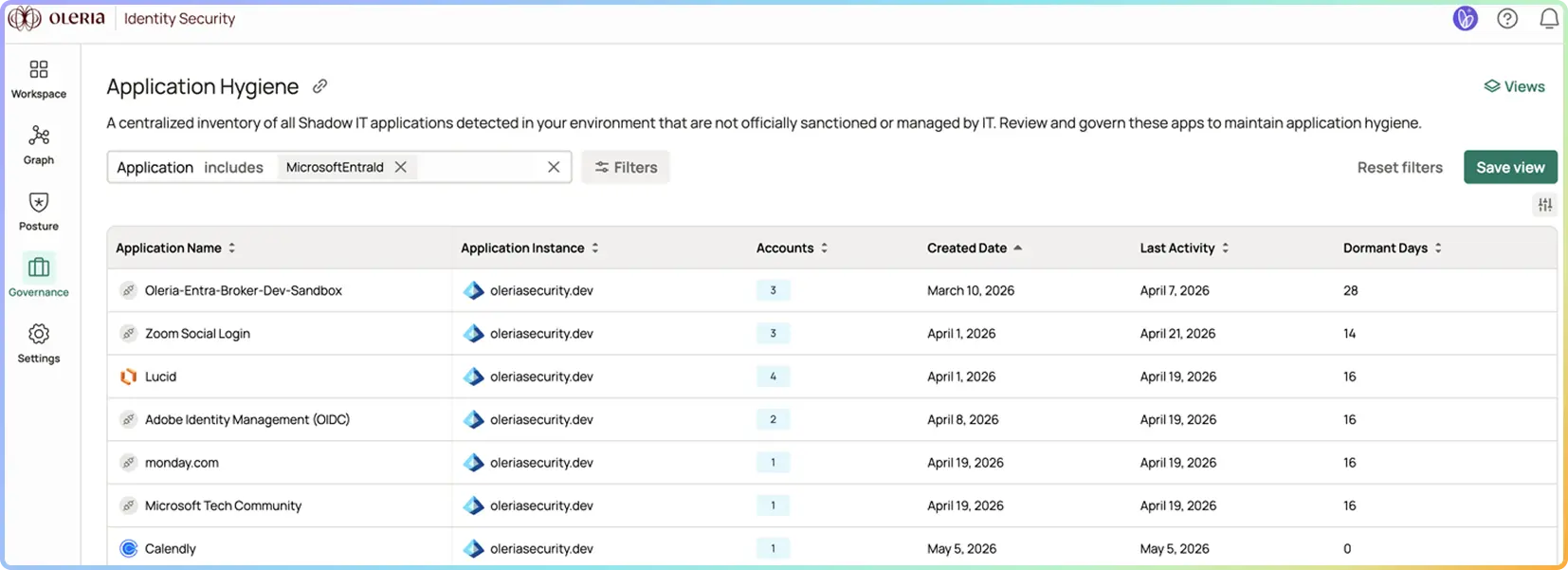
· Complete OAuth grant inventory. Oleria ingests all OAuth consent grants from connected IDPs and platforms — Entra ID (via Microsoft Graph oauth2PermissionGrants), Okta, and Google Workspace — building a continuously maintained inventory of every third-party application that has been granted access to corporate identity and data. Each grant record captures: the application name and publisher, the granting user identity, the OAuth scopes authorized, the grant issuance date, and the platform it was issued on.
· Unmanaged application identification. OAuth grants are cross-referenced against the organization's approved application catalog. Applications with active grants that are not in the catalog — not formally reviewed, approved, or provisioned by IT — are classified as shadow IT applications. The shadow IT application population is surfaced as a distinct inventory, separate from formally managed SaaS integrations.
· Application risk classification. Shadow IT applications are classified by risk based on: the OAuth scopes they have been granted (read-only vs. read-write, narrow vs. broad), the publisher's verification status (verified vs. unverified), the number of users who have authorized the application, and whether any authorizing users hold privileged accounts. Applications with broad scopes from unverified publishers authorized by multiple employees are surfaced as the highest-risk shadow IT findings.
· Over-scoped grant detection. Applications authorized with scopes significantly broader than their stated functionality requires are flagged as over-scoped. A note-taking application authorized with full mailbox read-write access is over-scoped for its function — a risk signal that the grant was authorized without scrutiny of the permissions requested.
· Privileged account grant audit trail. Every OAuth grant issued by a privileged account is recorded in Trustfusion with the application name, scopes, grant date, and current status. Security teams can query the full history of OAuth grants from privileged accounts — for incident investigation, compliance evidence, or routine privileged account governance review.
· Stale and dormant grant detection. OAuth grants for applications that have not been actively used within the configured activity window are flagged as dormant. A grant that was authorized two years ago for a productivity tool the employee no longer uses still holds valid access to their data. Dormant grants represent standing exposure with no current business value.
· Post-offboarding grant persistence. When an employee is offboarded, Oleria checks for active OAuth grants associated with their identity — including grants made using local SaaS credentials that the IDP deprovisioning workflow did not reach. Active grants belonging to departed employees are surfaced as critical post-offboarding findings for immediate revocation.
· Posture Campaigns for grant revocation. Risky, dormant, over-scoped, and post-offboarding grant findings are packaged into Posture Campaigns with assigned owners and due dates. IT admins and application owners are provided the specific grant details and the revocation path for each platform — Microsoft Graph consent revocation, Google OAuth token revocation, or application-level access removal. Revocation is tracked to confirmed closure in the Access Graph.

Shadow IT discovery and OAuth grant governance runs through a four-stage continuous pipeline:
Stage 1 — Evaluating Entra ID, Okta, and Google Workspace OAuth Posture to Generate Findings: Oleria Trustfusion evaluates each OAuth grant against configurable policy: high-risk scopes on any account are findings; high-risk scopes on privileged accounts are critical findings; shadow IT applications with broad organizational grants are critical findings; dormant grants beyond the configured threshold are stale access findings; grants associated with departed employees are post-offboarding persistence findings. Each finding is typed, severity-scored, and attributed to a remediation owner.
Stage 2 — Visualizing, Revoking, and Evidencing Shadow IT Grants via the Posture Dashboard: Shadow IT and OAuth grant findings surface in the Posture Dashboard filterable by application, scope risk tier, granting identity type (privileged, standard, external), grant age, and employment status of the grantor. Posture Campaigns route revocation assignments to IT admins with platform-specific revocation guidance. When a grant is revoked, the Access Graph is updated and the finding closed. The full record — grant discovered, finding opened, revocation actioned, closure confirmed — is retained as audit evidence.
A mature shadow IT governance program transforms the OAuth grant landscape from an unquantified blind spot into a continuously monitored, risk-bounded part of the identity security program:
· Complete shadow IT application inventory, always current. Every third-party application with an active OAuth grant to any corporate identity is known, classified, and risk-rated in Trustfusion. The shadow IT application population is quantified, trended, and reported to security leadership — not an unknown of unknown size.
· No high-risk OAuth scopes on privileged accounts. Every OAuth grant issued by an account holding a privileged role is reviewed and approved or revoked. No privileged account has an active grant to an unverified or unapproved application with broad mailbox, file, or directory scopes. This is a tracked, zero-tolerance posture target.
· No active grants from departed employees. Post-offboarding OAuth grant persistence is detected within hours and revoked within 24 hours. No former employee's OAuth grants — including those made with local credentials outside the IDP deprovisioning scope — remain active after departure. This is confirmed in Trustfusion, not assumed from IDP deprovisioning logs alone.
· Dormant grants cleaned up on a defined cadence. OAuth grants for applications not actively used within the configured window are surfaced and revoked on a defined remediation schedule. The dormant grant population trends downward over time as the program matures. Grant hygiene is reported alongside account hygiene as a connected identity posture metric.
· Organizational admin consent grants reviewed and minimized. All admin-consented OAuth grants that apply organization-wide are documented, reviewed for scope appropriateness, and owned by a named IT stakeholder. New organizational grants generate immediate review findings before they become standing broad-access exposure.
·Shadow IT governance integrated into the access review program. OAuth grants from privileged accounts are included in privileged account access reviews. High-risk application grants appear in employee access certifications. Shadow IT is not an afterthought — it is a governed dimension of the access posture program, with evidence available for auditors on demand.

Self-service authorizations make it easy for employees to connect unverified tools directly to sensitive mailboxes and cloud folders, bypassing traditional defenses completely. Quantify your hidden security gaps—request Oleria's Identity Security Maturity Assessment to accurately assess, benchmark, and optimize your security posture leveraging our industry-backed identity maturity model.
Oleria ingests OAuth consent records directly from the IDP and platform APIs — not from employee self-reporting. In Microsoft Entra ID, the oauth2PermissionGrants endpoint exposes every delegated permission grant made by every user in the tenant, regardless of whether IT was involved. In Google Workspace, the Admin SDK tokens API exposes all OAuth tokens issued to third-party applications across the organization. Oleria reads these records continuously, so every authorization event — whether a standard employee or an administrator clicked "Allow" — is captured in the grant inventory.
A user consent grant is an OAuth authorization made by an individual employee for their own account — they authorized a third-party application to access their email, files, or calendar. The grant applies only to that user's data. An admin consent grant is an authorization made by an IT administrator on behalf of the entire organization — the third-party application is granted access to all users' data matching the authorized scopes, without requiring each individual to consent. Oleria surfaces both grant types, but treats organizational admin consent grants as the higher-risk category due to their organization-wide impact.
Privileged accounts — executives, IT administrators, security leads, finance directors — have access to data and systems that are more sensitive than those of standard users. When a privileged account authorizes an OAuth grant, the third-party application gains access to that account's mailbox, files, and calendar — which may contain board materials, financial records, security configurations, HR data, or strategic plans. The blast radius of an OAuth grant is a direct function of the granting account's access scope. A grant from a Global Administrator with full mailbox and file access to an unverified application is a fundamentally different risk level from the same grant issued by a standard user.
Trustfusion supports both guided and automated revocation for OAuth grants. In guided mode, Posture Campaigns notify IT admins with the specific grant details and the revocation steps for each platform — Microsoft Graph API consent revocation for Entra ID grants, Google token revocation for Workspace grants. For high-confidence scenarios — such as grants from departed employees, or grants to applications on a blocklist — automated revocation workflows can be configured that initiate the platform API call and confirm closure in the Access Graph without manual intervention. Automation scope is configurable by grant type, scope risk tier, and granting identity type.
Shadow IT governance and formal SaaS management are complementary programs. The formal process governs applications that IT has reviewed, approved, and provisioned through the IDP. Shadow IT governance addresses everything that bypassed that process — the applications employees authorized directly through OAuth without IT involvement. Oleria surfaces shadow IT applications as candidates for either formal adoption (move to the managed catalog with appropriate controls) or revocation (remove the grant and block the application from future authorization). Over time, the program produces a smaller, better-governed OAuth grant landscape where the distinction between managed and unmanaged applications is actively maintained.
Standard IDP deprovisioning — deactivating the Entra ID or Okta account — invalidates OAuth tokens issued through that IDP account. However, OAuth grants made using local SaaS application credentials, or grants issued before a federated login change, may retain valid tokens even after the IDP account is disabled. Oleria's post-offboarding grant check specifically covers this gap: it cross-references active OAuth grants against HR and IDP termination status, identifies grants that persist after the employment end date through any credential pathway, and surfaces them as critical findings for immediate revocation.
SOC 2 Type II (CC6.6) specifically requires that transmitted and authorized access to data be restricted to authorized personnel — unauthorized OAuth grants to unapproved applications are a direct gap in this control. ISO/IEC 27001 (A.6.3 and A.9.4) requires controls over third-party access to organizational information systems. NIST SP 800-53 (AC-20 Use of External Information Systems and SA-9 External Information System Services) requires documented controls over external system access to organizational data. GDPR and CCPA data governance requirements around third-party data access are directly relevant to OAuth grants that expose personal data to unapproved applications. Trustfusion's grant inventory, risk findings, and revocation records provide the evidence these frameworks require.