Quick summary: Centralized identity provider controls fall short when unmapped application silos allow users to authenticate using direct, local app overrides. Integrating metadata fields with Oleria Trustfusion, an AI-native identity security platform, brings rigorous local account password hygiene auditing to the edge of your cloud enterprise. This unified posture engine traces hidden non-human identities, maps unrotated credentials, and unmasks deep access paths to eliminate credential exposures before they can be leveraged by initial access brokers.
Security teams gain continuous, cross-environment visibility into password hygiene posture — identifying accounts with stale, never-changed, or non-expiring passwords; accounts that rely on passwords alone without MFA; accounts with shared credentials; and local application accounts that bypass IDP password policy enforcement entirely. Findings are surfaced as prioritized posture findings and driven to remediation through structured campaigns — with privileged accounts, external identities, and non-human identities all in scope.
Why password hygiene still matters in 2026: Despite the push toward passwordless and MFA-first authentication, passwords remain the primary credential type for a large share of enterprise accounts — especially local SaaS accounts, service accounts, shared credentials, and legacy system access. Credential-based attacks remain the leading initial access vector in enterprise breaches. Knowing which accounts have stale passwords, and which lack any compensating control like MFA, is a foundational identity security control that most organizations cannot answer consistently across their full account population.
Password hygiene visibility sounds straightforward but breaks down quickly across a real enterprise environment. Policy enforcement at the IDP covers only accounts that authenticate through the IDP — and even then, the policy's actual effect on each account's password state is rarely verified holistically. Without a unified platform, teams face:
· IDP password policy covers only IDP-managed accounts. Okta and Entra ID enforce password complexity, rotation, and history requirements for accounts they manage directly. But accounts that authenticate locally to SaaS applications — bypassing IDP SSO — are outside that policy scope entirely. These local accounts may have passwords set years ago, with no rotation, no complexity requirement, and no visibility to the security team.
· No cross-application password hygiene view. Each SaaS application tracks its own password metadata independently — when a password was last set, whether it has ever been changed, whether it meets complexity policy. There is no native tool that aggregates this signal across applications to produce a single hygiene posture view for the full account population.
· Shared credentials are invisible. When multiple users share a single set of application credentials — a common practice for vendor portals, legacy systems, or team-shared service accounts — the sharing relationship is typically undocumented, and the credential is never rotated because no one is accountable for it. These accounts are high-risk and effectively invisible to standard access governance tools.
· Non-human identity credentials are unmanaged. Service accounts, API integrations, and automated pipelines authenticate with passwords or static credentials that are often set once and never rotated — sometimes for years. NHI credentials are rarely subject to the same policy enforcement that applies to human accounts, and their hygiene state is almost never assessed alongside the human account population.
· Password age and never-changed accounts are unknown. Most organizations cannot answer "which accounts have never had their password changed?" or "which accounts have passwords more than 365 days old?" across their full application estate without pulling and reconciling exports from every system that stores password metadata — a slow, incomplete process.
· No correlation between password hygiene and account privilege or risk. Even when some password hygiene data is available, it exists in isolation — not correlated to account privilege level, data access scope, or MFA status. A stale password on a standard user account is a different risk level than a stale password on an admin account with no MFA and access to production systems. Without correlation, teams cannot prioritize effectively.
Oleria Trustfusion ingests password hygiene signals from IDPs and SaaS application connectors and surfaces them in the context of each identity's full access profile — privilege level, MFA status, dormancy, account type, and data access scope. The result is a risk-prioritized, continuously maintained password hygiene posture across the entire account population, including accounts that live outside IDP policy enforcement.
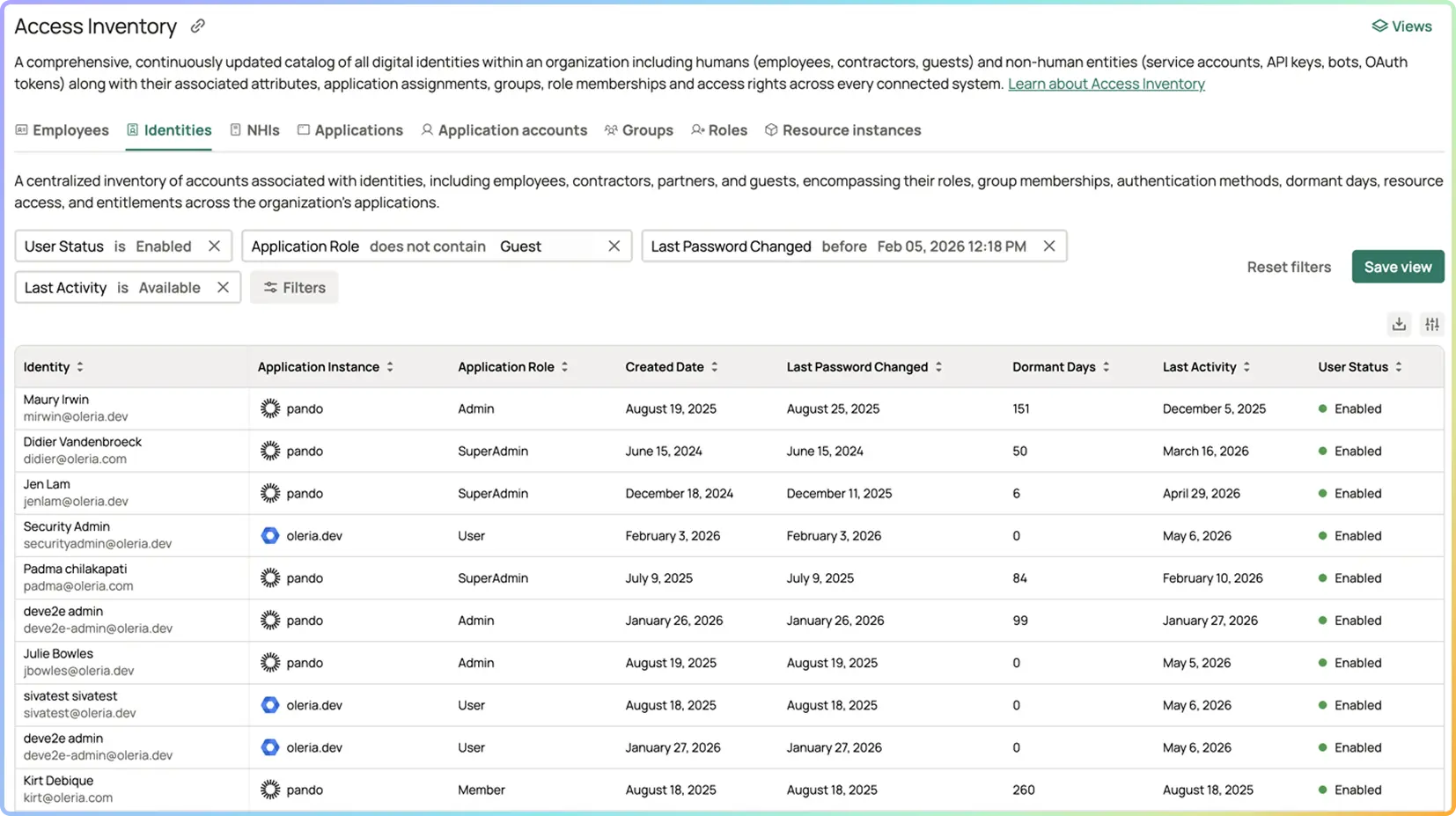
· Password age and last-changed timestamp. For every account where password metadata is available — IDP-managed accounts and local SaaS accounts — Oleria surfaces when the password was last set or changed. Accounts whose passwords have not been changed beyond a configurable age threshold are flagged as stale credential findings.
· Never-changed password detection. Accounts where the password has never been changed since initial provisioning are identified as a distinct finding type. These accounts — common among service accounts, legacy integrations, and long-tenured employees who were never required to rotate — represent a persistent and often overlooked credential risk.
· Non-expiring password accounts. Accounts configured with passwords that never expire — a common setting for service accounts and shared credentials — are surfaced and evaluated against policy. Non-expiring passwords on privileged or NHI accounts are flagged as high-severity findings requiring either rotation enforcement or compensating controls.
· Local account credential exposure. Accounts that authenticate to SaaS applications with local credentials — bypassing IDP SSO and therefore bypassing centralized password policy — are identified and their password hygiene state is evaluated where accessible. Local privileged accounts with stale passwords are treated as critical-severity findings.
· Shared credential detection. Where shared account patterns are detectable — through account naming conventions, concurrent session signals, or explicit shared-account classification in the identity data — these accounts are flagged for review, owner assignment, and credential governance.
· NHI credential hygiene. Service accounts, integration accounts, and other non-human identities that authenticate with static passwords are included in password hygiene evaluation. NHI credentials that have not been rotated within the configured threshold, or that are configured as non-expiring on accounts with broad access, are surfaced as posture findings.
· Password hygiene correlated to privilege level. Password hygiene findings are scored in the context of each account's privilege tier. A never-changed password on a Snowflake ACCOUNTADMIN or a Salesforce System Administrator is a critical finding. The same signal on a standard user account in a low-sensitivity application is a lower-priority remediation item. Prioritization is automatic and risk-proportionate.
· Combined with MFA posture. Accounts with poor password hygiene and no MFA enrollment represent the highest-risk credential posture in the environment. Oleria surfaces this combined signal — stale password plus no MFA, or local account plus never-changed password — as a composite risk finding requiring immediate remediation, rather than two separate findings that might each be deprioritized in isolation.
· External and guest account credential posture. Contractor and vendor accounts with stale or never-changed passwords — especially those with access to sensitive systems — are flagged as high-priority external identity risk findings, consistent with the broader external identity governance posture in Trustfusion.

Stage 1 — Continuous Ingestion of Password Metadata Across Okta, Entra ID, and SaaS Silos: Oleria connectors pull password hygiene signals from IDPs (Okta, Microsoft Entra ID) and SaaS application connectors where password metadata is available via API — including last password set date, password expiry configuration, password-never-expires flag, and account type (local vs. SSO-federated). HR system data provides employment status and organizational context. Privilege tier is derived from the Access Graph. All signals are ingested continuously, not on a periodic export schedule.
Stage 2 — Correlating Local Salesforce and GitHub Credential States in the Access Graph: Password hygiene signals from different source systems are normalized and correlated to each canonical identity object in the Access Graph. A single user's password state across their IDP account, their local Salesforce account, and their GitHub account are all attributed to the same identity record and evaluated together — giving a complete per-identity credential hygiene picture rather than a per-application fragment.
Stage 3 — Evaluating Snowflake and SaaS Credential States Against Posture Policies: Oleria Trustfusion evaluates each account's password attributes against configurable policy thresholds: maximum password age (e.g., 90 days for standard accounts, 30 days for privileged accounts), never-changed password as an automatic finding, non-expiring password configuration on privileged or NHI accounts, and local account credential exposure on any account above a defined privilege tier. Risk scoring combines password hygiene signals with privilege level, MFA status, and account type to produce a prioritized finding list.
Stage 4 — Running Targeted Posture Campaigns to Enforce Password Hygiene Remediation: Findings surface in the Posture Dashboard with filters for finding type, privilege tier, identity type, and application. Posture Campaigns assign remediation ownership with due dates and workflow integration. When a password is rotated or a policy is applied, the Access Graph is updated and the finding is resolved. The complete record — finding opened, owner assigned, action taken, finding closed — is retained as timestamped audit evidence.
A mature password hygiene posture program produces measurable, continuously validated outcomes across the full account population:
· No privileged account with a stale or never-changed password. Every privileged account across every connected system has a password that meets the configured age threshold. Never-changed password findings on privileged accounts are treated as critical and resolved within a defined SLA — not left open because they were unknown.
· No local privileged accounts without compensating controls. Every account with a privileged role that authenticates locally — outside IDP SSO and outside centralized password policy — is known, documented, and subject to equivalent credential hygiene requirements. The population of local privileged accounts is measured and trends downward over time.
· NHI credentials governed and rotated on schedule. Every service account and integration credential with a static password has a documented rotation schedule, an assigned owner, and an enforced maximum credential age. Non-expiring password configurations on NHI accounts with broad access are an exception requiring explicit justification, not the default.
· Password hygiene and MFA posture evaluated together. The combined credential posture — password hygiene plus MFA enrollment and enforcement — is visible for every account, enabling security teams to prioritize the accounts where both controls are weak and risk is highest.
· Hygiene findings resolved within defined SLAs. All open password hygiene findings have an assigned owner, a due date, and a tracked status in Trustfusion. Mean time to remediation is measured by finding type and privilege tier, and trends over time are reported to security leadership as a credential hygiene KPI.
· Compliance evidence produced on demand. Password policy compliance evidence — which accounts meet policy, which had findings, what remediation was taken, and when — is available from Trustfusion directly for SOX, SOC 2 Type II, ISO 27001, NIST SP 800-53, and PCI DSS auditors, without manual report assembly.

Enforcing strong password complexity in your central identity provider does nothing to stop isolated local account creations or aging service tokens. Eliminate your credential blind spots—book a personalized demo today to see how Oleria Trustfusion automates local account password hygiene auditing across your complete application catalog.
No. Oleria never accesses, stores, or evaluates actual passwords or password hashes. Password hygiene visibility is based entirely on metadata — the attributes that IDPs and SaaS applications expose via their APIs, such as password last set date, password expiry configuration, and whether a password has ever been changed. Oleria's posture evaluation works entirely at the metadata layer, with no access to credential content.
From Okta, Oleria ingests password last changed timestamp, password policy assignment per user, and whether the account is subject to Okta's password policy or authenticates via an external IDP (federation). From Microsoft Entra ID, Oleria ingests last password change date, password policies applied to the account, the password never expires flag, and whether the account authenticates via Entra ID credentials or a federated identity provider. Both sources are ingested continuously via their respective Graph APIs.
Oleria does not perform cross-system password comparison — it does not have access to password content or hashes and therefore cannot detect credential reuse directly. However, Oleria can surface the risk conditions that make credential reuse dangerous: accounts with never-changed or very old passwords across multiple systems, local accounts that bypass IDP SSO (and therefore have independently managed credentials), and accounts with no MFA that would benefit from forced rotation. Organizations concerned about credential reuse should pair Oleria's posture visibility with a credential exposure monitoring tool (such as Have I Been Pwned enterprise integrations or identity threat detection platforms) that operates at the credential layer.
Non-human identities — service accounts, integration accounts, API credential holders — are included in password hygiene evaluation as first-class identity objects in the Access Graph. Where password metadata is available for NHI accounts via connector APIs, Oleria evaluates it against configurable thresholds. NHI accounts with non-expiring passwords, never-rotated credentials, or broad access scope are flagged as posture findings. Each NHI finding is attributed to the account's human steward for remediation ownership.
Yes. Oleria's connector layer ingests account and password metadata directly from SaaS applications — not only from the IDP. Local accounts in Salesforce, GitHub, Snowflake, and other connected applications that authenticate with application-managed credentials are included in password hygiene evaluation. These local accounts are often the highest-risk credential posture gap because they sit entirely outside IDP policy enforcement.
IDP password policies enforce requirements at authentication time for the accounts they directly manage. Oleria provides the assurance layer — verifying that policy enforcement is complete, that accounts are actually meeting the policy requirements in practice, and that the full account population (including local accounts and NHIs outside IDP scope) is evaluated. Think of Oleria as answering "is our password policy actually working, for every account?" — a question that IDP admin consoles alone cannot answer comprehensively.
PCI DSS v4.0 (Requirements 8.3 and 8.6) mandates password complexity, rotation, and history requirements for all accounts with access to cardholder data systems, with additional controls for service accounts. NIST SP 800-53 (IA-5 Authenticator Management) requires documented credential lifecycle management including rotation and complexity. ISO/IEC 27001 (A.9.4) requires access control including password management policy. SOC 2 Type II (CC6.1) includes logical access controls covering password policy. SOX ITGC requires evidence of password policy enforcement for financially significant systems. Trustfusion retains the current compliance posture and historical remediation records needed to evidence these controls across all frameworks.