Quick Summary: Oleria Trustfusion, an AI-native identity security platform, transforms evidence-based access reviews by surfacing actual usage signals, peer-group analysis, and HR changes on every review line — so reviewers approve on data, not memory, and reviews complete in days, not weeks.
Run access reviews driven by usage evidence, not user attestation.
Reviewers see what was actually used. Approvals are evidence-based. Reviews complete in days, not weeks.
Traditional access reviews ask reviewers — typically managers — to confirm that each report needs the access they have. Reviewers don't know what their reports actually use; they approve everything to avoid disrupting work. The review consumes weeks of effort and produces approvals that don't reflect actual need.
The result is well-documented in audit findings: reviews complete on time, but the access set never narrows. Auditors increasingly press on the question of whether the review is doing real work. The IGA tools that drive the review have no way to surface usage evidence to the reviewer. After deploying Oleria, Aireon replaced 24,000 hours of projected manual review effort with continuous automated monitoring — the speed at which the control becomes real. As Peter Clay, CISO at Aireon, puts it: "Speed kills all problems. So it's just how fast can we adapt? How fast can we react?"
Oleria Trustfusion surfaces dormancy, peer signals, and AI-recommended decisions per line so evidence-based access reviews complete in 30–60 minutes per manager.
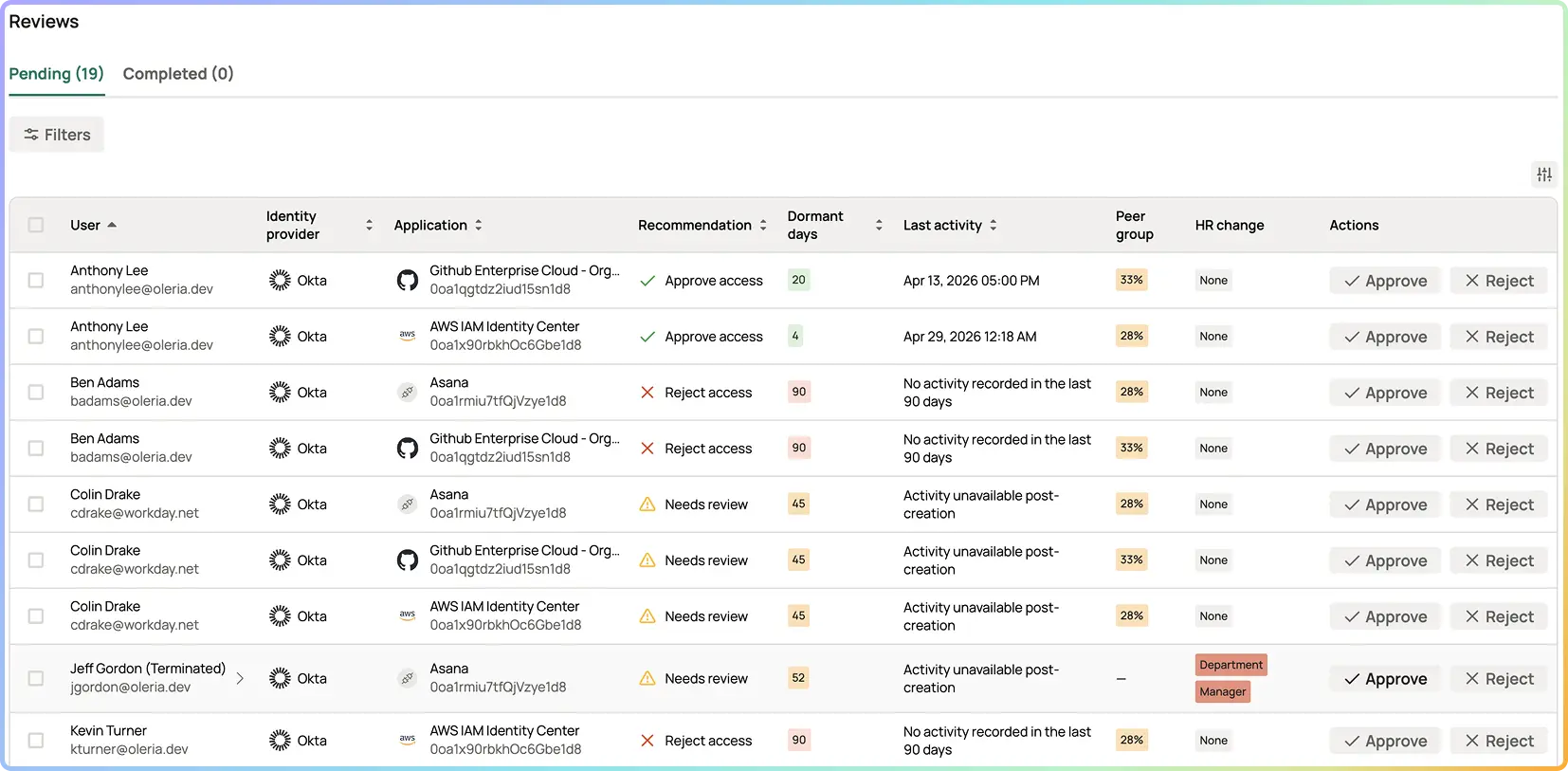
Each line shows what was actually used in the threshold period — reviewers approve on evidence, not memory.
Oleria recommends a decision per line based on usage and peer signals. Reviewers accept the recommendation in bulk or override per line.
Access patterns common to the role are surfaced; outliers (one report has access nobody else on the team has) are flagged for explicit review.
Reviewer, decision, evidence, timestamp — captured per line. The review becomes the audit evidence; no separate report assembly needed.
Oleria's AI proposes a default decision for every line based on usage and role context, and flags the outliers worth a human look. The reviewer accepts in bulk and spends real attention only where it matters.
Time to complete a quarterly review cycle Weeks → days
Manager time per review Hours → 30–60 minutes
Access actually narrowed by review From near 0 to materially significant
Audit findings on review quality Eliminated

Start with privileged or regulated-data scope; by the fourth cycle the review just runs.
Usage-driven reviews produce stronger evidence than self-attestation across SOX, HIPAA, ISO 27001.
Override per line with justification logged in the audit trail.
Last-used date, dormant days, peer-group context, HR changes, and recommended decision.
Each line shows what was used with a recommended decision — confirm the recommendation, not reason from memory.
Reviewers confirm access without evidence and rubber-stamp to avoid disruption.