Summary: Audit cycles drain GRC teams with weeks of manual evidence assembly — pulling CSVs from thirty admin consoles and stitching them into auditor-readable format. Oleria Trustfusion, an AI-native identity security platform, eliminates that scramble with continuous audit-ready identity evidence capture from every access review, lifecycle event, and posture action. GRC leads query Oleria's MCP server in natural language and receive evidence assembled live from underlying records, with citations back to source.
Evidence ready for any audit, on demand.
Continuous capture from every Oleria flow. MCP-based audit assembly — connect Claude or any MCP client to your Oleria tenant and pull the evidence the auditor needs, live from real records. Pre-built framework-mapped packs coming next.
Every audit cycle is the same scramble: pull access lists, prove who has what, prove who reviewed what, prove who fixed what, assemble the evidence into the auditor's preferred format, sign it. The team works overtime; the audit lasts longer than it should; the same work happens again next quarter.
The pain isn't the audit — it's the assembly. The data exists; it's spread across thirty admin consoles, three IGA tools, and a SharePoint folder of attestations. Centralizing for the audit is the work. Without a single source of truth, the team will keep doing this work every cycle. As Peter Clay, CISO at Aireon, puts it: "Oleria is one of those things that once you see it and get it, it's hard to imagine doing what you've been doing without it.
Oleria's MCP server delivers audit-ready identity evidence on demand — no spreadsheet stitching, just live records with citations the auditor can validate.
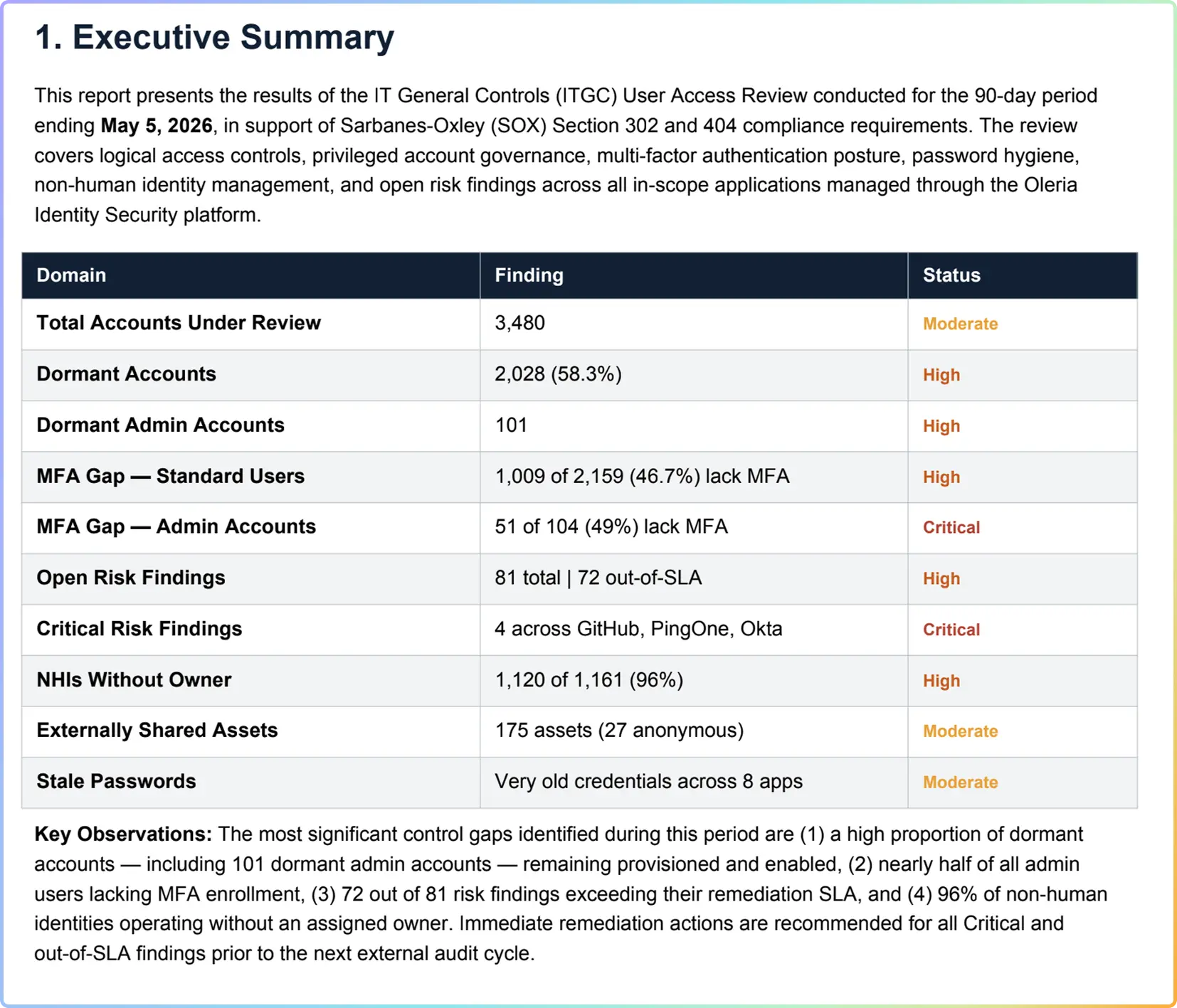
Every right-sizing, every review, every JML event, every SOD evaluation, every hygiene action — captured with operator, timestamp, before/after. The audit trail is the byproduct of operations, not a separate assembly project.
Connect Claude or any MCP client to your Oleria tenant via the Oleria MCP server. Ask for the evidence the auditor needs; the response assembles live from underlying records, with citations back to source. No CSV exports stitched in spreadsheets.
Coming next. Curated mappings for SOX (ITGC, application controls, SOD), HIPAA, PCI-DSS, ISO 27001, NIST CSF, NIST 800-53. Pre-built mapping is one-time setup; pack export reuses it per cycle. Until they ship, framework evidence is assembled live via MCP.
Same underlying records flow into every audit. SOX and ISO 27001 audits use the same access data, reframed per framework. The data layer is the data; framework mapping is reformatting on top.
Oleria's MCP server exposes the access graph, audit trail, and lifecycle records to MCP-capable AI clients. Auditors and GRC leads can query in natural language — "show every privileged-access review decision in Q1 with the reviewer and the dormancy signal at the time" — and the answer assembles from real records with citations to source. Pre-built framework-mapped packs add a curated layer on top, coming next.
Audit cycle effort Weeks of assembly → days of review
Cross-framework evidence reuse Same data, different mappings
Auditor confidence in evidence Materially higher
Audit findings on evidence quality Eliminated

Customer signal: audit cycle effort moves from weeks of assembly to days of review. Big Four engagements run shorter because the auditor's data requests are answered immediately rather than after a 30-day collection. Cross-framework audits (SOX + ISO 27001 + HIPAA in the same year) reuse the same evidence with different mappings, multiplying the reduction.
GRC tools track findings against controls based on attestations and self-reports. Oleria's evidence is observed: the actual access state, the actual decisions, the actual remediations — with timestamps and operator records. The two are complementary; Oleria becomes the evidence layer underneath the GRC tool, queried directly via MCP or stitched via export.
The audit pack supports manual evidence attachments — policy documents, approval records from external systems, screenshots from non-connected apps. Oleria provides what it observes; the rest of the evidence collection process still uses normal tools. The MCP query layer can stitch Oleria's records with linked external evidence in the same answer.
Coming next. Curated mappings for SOX (ITGC, application controls, SOD), HIPAA (administrative, technical, audit), PCI-DSS (Requirement 7), ISO 27001 (A.9), NIST CSF, NIST 800-53. Mapping is one-time setup per framework; pack export reuses it per cycle. Until pre-built packs ship, framework evidence is assembled live via the MCP server using natural-language queries.
Per operation: operator, action, target, before/after, timestamp. Every right-sizing, every review decision (with the dormancy/peer/HR signals shown at decision time), every JML event, every SOD evaluation, every hygiene action. Plus the underlying state — every access grant, every revocation, every approval — across every connected app. Continuous; no separate logging project.
Oleria runs an MCP (Model Context Protocol) server that exposes access-graph, audit-trail, and lifecycle records to MCP-capable AI clients — Claude, MCP Inspector, custom GRC tools. Auditors and GRC leads ask in natural language; the response assembles from underlying records with citations to source. The auditor reads, validates against source data, and signs — without a 30-day collection project.