Summary: Large Entra ID user populations are impractical to review as a single campaign — the result is shallow rubber-stamp certification or no review at all. Oleria Trustfusion, an AI-native identity security platform, solves this with Entra ID access certification scoped by employee attribute — department, manager, or start date — so security teams run tractable, evidence-driven reviews on the populations that matter most, at the cadence each risk tier requires.
Certify Entra ID access, scoped by employee attribute.
Run Entra ID access reviews on the population that matters now — finance department this quarter, recent joiners next month, contractors at renewal. Application campaign on the Entra ID app via Entra; same three-signal engine (Dormant Days, Peer Group, HR Changes) on every line.
Entra ID user populations are large and diverse — a 1,500-user Entra ID review run as one campaign is impractical for any reviewer to act on. Most enterprises either skip the review (audit gap) or revert to spreadsheet-driven sampling that produces weak evidence.
Without a way to scope the review to a tractable population, Entra ID governance defaults to the path of least resistance. The audit finding is routine: the Entra ID review ran, but the evidence is shallow, the decisions rubber-stamped, the scope unclear.
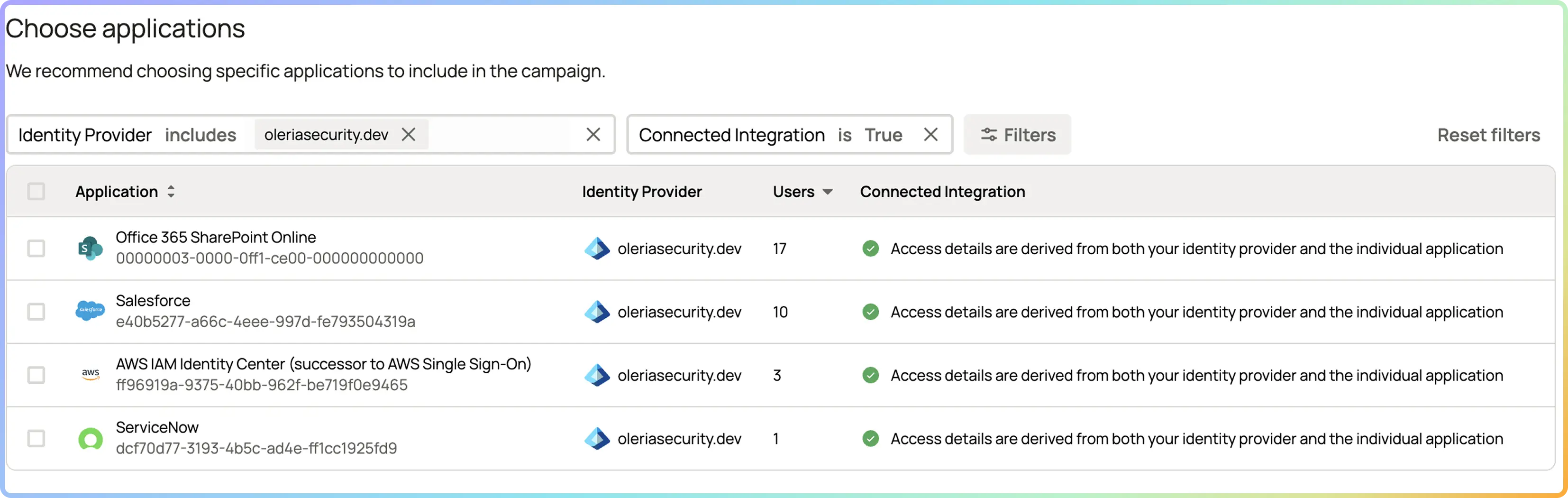
Application campaign on the Entra ID application(s) in Entra ID. Each user's Entra ID access reviewed at the app-instance level using the same three-signal engine that powers every Oleria review.
Dormancy in days, peer match, HR change — applied to Entra ID access the same way as every other app.
Slice the review by department, manager, or start date so the population is tractable. Run separate scoped campaigns on a faster cadence for higher-risk slices (finance, executives, contractors); standard cadence for the rest.
Same continuous-capture audit trail as every other Oleria flow. CSV export today, MCP-based assembly via Oleria's MCP server, framework-mapped packs coming next.
The same three-signal engine that powers every Oleria review applies to Entra ID. Recommendations per line, bulk-accept on the routine, attention on the outliers — within a population scoped to what matters.
Time to certify a focused Entra ID slice Weeks → days
Reviewer effort per cycle Tractable (scoped population)
Audit findings on Entra ID review depth Eliminated for app-instance reviews
Coverage of high-risk Entra ID populations Faster cadence per slice

A 1,500-user Entra ID review run as one campaign produces weak evidence — reviewers can't sustain the volume. Oleria's attribute-scoped campaigns make Entra ID certification tractable, evidence-driven, and cadence-flexible. See how it works for your environment.
SOX, HIPAA, ISO 27001, PCI DSS 4.0, GDPR. The underlying evidence is the same review record; framework-specific mapping reformats per audit. CSV export today, framework-mapped packs coming next.
Yes. Oleria reads access through the Entra ID connectors but doesn't replace the Entra ID admin console. Day-to-day product administration stays where Entra ID admins already work. Oleria provides the access-certification layer that previously lived in spreadsheets.
A 1,500-user Entra ID review run as one campaign is impractical to act on — reviewers can't sustain the volume. Slicing by department, manager, or start date breaks the population into tractable batches that map to a real reviewer's accountability (finance manager reviews finance team's Entra ID). Risk-tiered cadences become possible: faster on the highest-risk slices, standard on the rest.
Define a campaign with the Entra ID app(s) selected, then filter the user population by department, manager, or start date. Oleria runs the campaign against only that slice. Run multiple slices in parallel — finance team quarterly, recent joiners on a 30-day cycle, contractors at renewal — each with its own reviewer assignment and cadence.
User-level access to the Entra ID application(s) as resolved through Entra ID — license assignment, role membership, and group-based access for Microsoft 365 services. Granularity is app-instance level. Per-site SharePoint permissions, per-channel Teams membership, and per-folder OneDrive permissions are not part of this outcome — that's resource-level review, on the platform roadmap.