
Quick Summary: Oleria, an AI-native identity security & governance platform, enables teams to implement Attribute-Based Access Review Scoping—slicing certification campaigns by department, manager, or start date so every reviewer works only the population they're accountable for, reducing noise and strengthening audit evidence.
Slice access reviews by employee attribute
Run the review on the population that matters now. Finance department this quarter. Recent joiners on a 30-day cycle. Contractors at renewal. The review's reach matches the reviewer's accountability, and risk-tiered cadences become straightforward.
Reviews scoped to "everyone with access to App X" are impractical when App X has thousands of users. Org-wide reviews fail under load — reviewers can't sustain the volume, and the ones that do produce weak evidence. Without a way to scope the review to a tractable population, governance defaults to skipping the review (audit gap) or rubber-stamping it (control failure).
Most IGA tools support filtering at submit time but treat slicing as an afterthought rather than a first-class scoping mechanism. The result: enterprises run one big review and either fail it or fake it, rather than running ten smaller reviews aligned to actual reviewer accountability. Attribute-Based Access Review Scoping turns unmanageable org-wide reviews into targeted, auditable cycles that reviewers can actually complete with confidence.
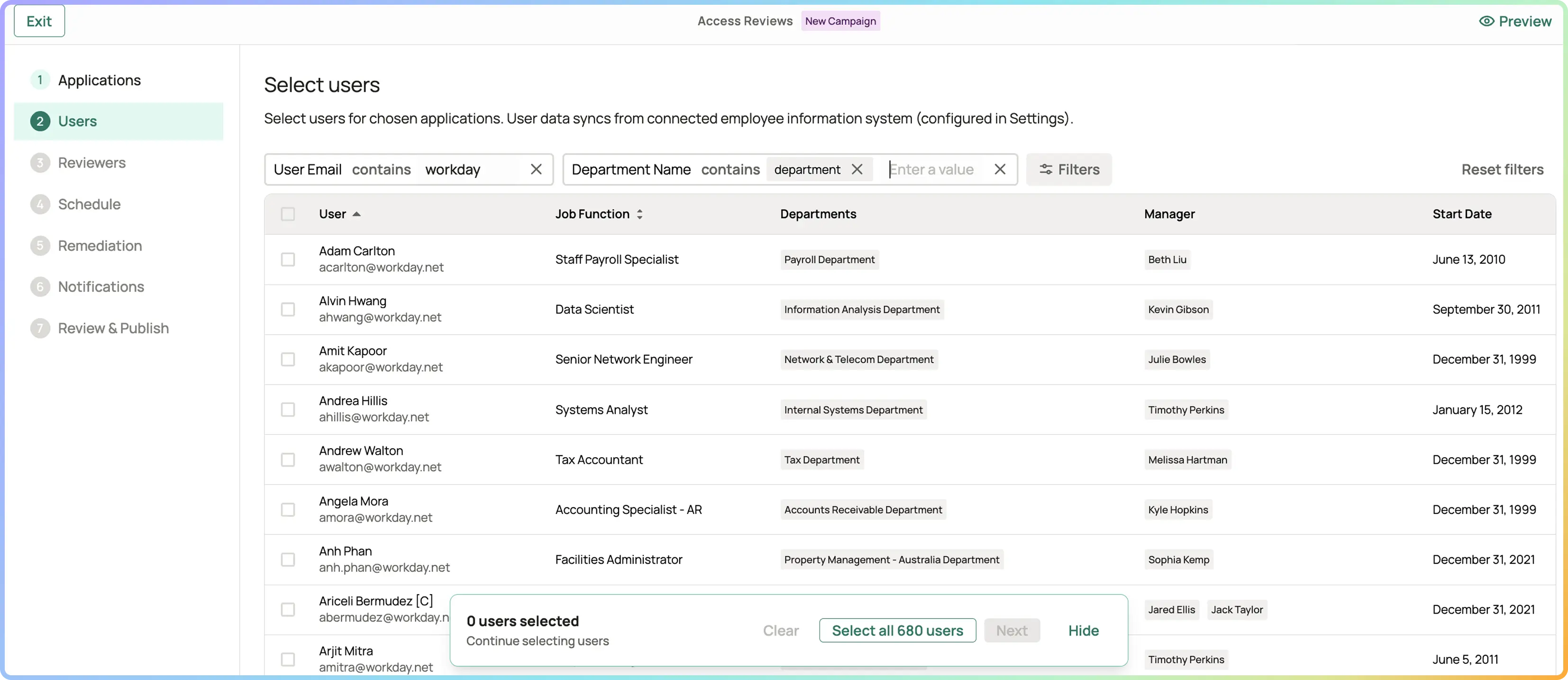
Run the review on a specific department's users only. Finance team's M365 access. Engineering's GitHub access. Sales's Salesforce access. The reviewer is the department's leader; the population is theirs to certify.
Run the review on a specific manager's direct reports. Maps the review's scope to org-tree accountability — the manager certifying knows the actual context.
Review the population that joined in the last 90 days, or 365 days, or before a specific date. Recent joiners are typically over-permissioned by joiner templates and least observed in operational data; a 30-day start-date slice becomes a recurring control on joiner hygiene.
Run the review on a specific job title across the company. Managers across Job titles are mapped automatically to review
The same three-signal engine (Dormant Days, Peer Group, HR Changes) drives recommendations within the sliced population. Slicing changes the scope; the intelligence per line is unchanged.

Slicing answers "what population." HR-change signals (D-13) answer "what changed." The two combine: run an HR-change-aware review scoped to the finance department, and you see only the finance employees with recent role / department / status changes — a tighter, more actionable cycle than a department-wide or org-wide review.
Direct manager filter today — review users who report to a specific manager. Transitive manager-tree filtering (the manager's manager's reports too) is a roadmap consideration; today, multi-level org reviews are run as separate slices per manager.
Recent joiners are typically the highest-risk slice. Joiner provisioning bundles can over-permission by template; new hires are also least observed in operational data, so dormancy and peer signals are noisier. A recurring "users joined in last 90 days" review becomes a hygiene control on the entry point rather than waiting for the next quarterly cycle to catch problems.
Department, Job function, manager, and start date today. The user population on a application can be filtered by any combination of these. Each slice produces its own scoped campaign with its own reviewer assignment and cadence.

