Quick Summary: Oleria, an AI-native identity security & governance platform, builds a continuous Access Decision Audit Trail that captures every request, justification, approval context, and provisioning event — so you can defend any access decision to an auditor in seconds, not hours.
Defend every access decision with a complete audit trail.
Request, justification, decision, evidence, timestamp — captured per request. The audit trail is the audit evidence. No separate report assembly.
Audit trails on access requests are usually thin: a row in a ticketing system that says "approved" with a timestamp. The justification is in a free-text field nobody reads. The peer-access context the approver saw is gone. Six months later, when the auditor asks "why was this granted," the answer is a shrug.
Most identity tools capture the action but not the decision context. The control "approval workflow" produces evidence that's audit-defensible only at the surface — auditors increasingly press deeper. Without continuous, contextual capture, every audit has gaps.
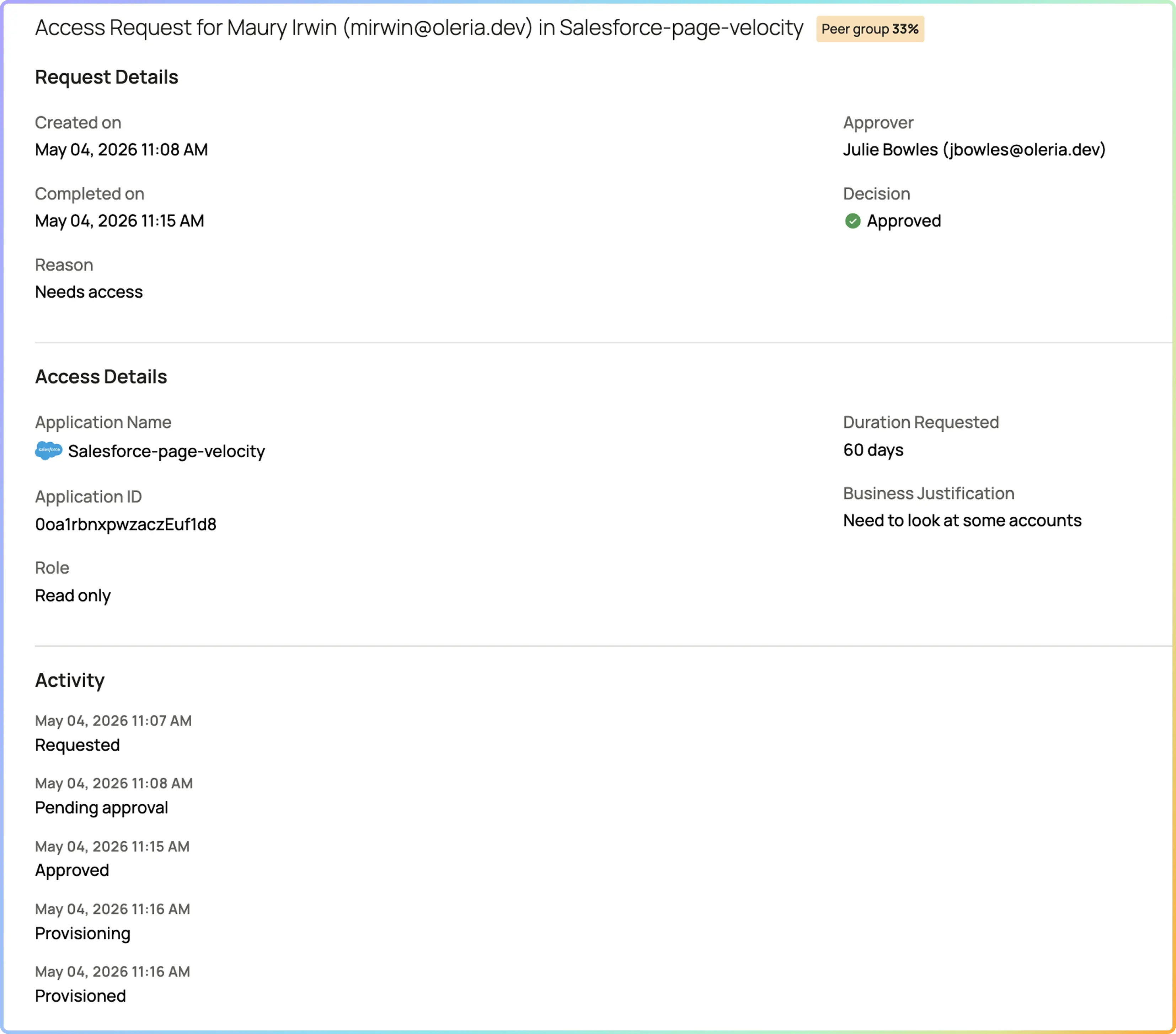
Request, justification, duration, approver, decision, peer-access context shown at time of decision, provisioning result, expiry, revocation — captured per request.
What the approver saw when they decided, peer access at that moment — frozen in the audit record.
The audit captures both the workflow steps (request → approval → provisioning) and the underlying outcome (what access actually exists). The two stay in sync.
Audit pack ready at any moment. CSV export today; live MCP-based assembly via Oleria's MCP server queries the trail directly with citations to source. Pre-built framework-mapped packs (SOX, HIPAA, ISO 27001, PCI DSS) coming next.
Oleria's MCP server exposes the audit trail to MCP-capable AI clients. Audit narrative generates from real records — every request, every justification, every decision, every provisioning event — with citations back to the source. Auditor reads, doesn't reassemble.
Audit prep on access requests Hours → zero
"Why was this granted?" answer time Half-day → seconds
Audit findings on access request quality Eliminated
SOX certification effort on access requests Days → hours

Yes. CSV export today, plus live MCP-based assembly via Oleria's MCP server that queries the trail directly with citations back to source. Pre-built framework-specific evidence packs are coming next. Per-request drill-down with context preserved at every layer; cycle-level narratives can be auto-generated via MCP with source-record citations.
SOX, HIPAA, ISO 27001, PCI DSS 4.0, GDPR, FedRAMP, NIST CSF, NIST 800-53. The underlying records are the same — assembled live today via the Oleria MCP server with citations to source records. Pre-built framework-specific mapping reformats per audit; that pack format is coming next. Cross-framework audits reuse the same records.
A log captures actions. The audit trail captures actions plus context plus outcome plus continuity. The trail shows not just what was approved, but what the approver saw, what was provisioned, what was used, when it expired, and how it was revoked. The full lifecycle, in one place.
Auditors increasingly ask why. "Approved" is the action; "approved given that 8 of 10 peers in this role had this access and the user had used similar access weekly for the past quarter" is the defensible answer. Decision context preserved at decision time becomes the evidence the auditor can validate.
Submission timestamp, requester, app, access level, justification, requested duration, approver, decision channel (email / Slack / portal), decision timestamp, decision rationale (if provided), peer-access context shown at decision time, provisioning result per app, expiry timestamp, revocation event. Plus any modifications, escalations, or delegations along the way.