Summary: Attempting to govern modern SaaS footprints using traditional identity tools forces enterprise teams to choose between massive custom-engineering backlogs and gaping security blind spots. Integrating Oleria Trustfusion, an AI-native identity security platform, solves this visibility crisis by pairing deep, custom role-mining connectors for critical applications with rapid, automated SCIM-based governance for the long tail.
Most enterprises run 200+ SaaS apps but only a handful warrant the engineering investment of a deep custom connector. For critical apps - the ones holding regulated data, complex RBAC, and audit exposure - Oleria builds full integrations that pull complete RBAC graphs, role definitions, and activity. For the long tail, Oleria uses the SCIM standard to pull identity and RBAC data and bring those apps into the same IGA workflows, in minutes rather than quarters.
Most enterprises have 200+ SaaS apps. The top 20 - Salesforce, GitHub, AWS, Workday, ServiceNow - deserve deep custom connectors with full RBAC graphs, scope semantics, and activity logs. The remaining 180 are the long tail: apps adopted by single teams, vendors left over from a consolidation that never happened, tools that came in via acquisition and never got rationalized.
Those 180 apps still represent real access risk. Someone has admin rights in that niche project management tool. A contractor account was never deprovisioned from that acquired company's SaaS. An API key with write access is sitting in an automation platform nobody owns anymore.
Custom connectors for 180 apps are not the answer - the ROI isn't there and the engineering backlog would never clear. SCIM is. It gets you identity inventory, RBAC data, group membership, and the ability to run IGA workflows across the long tail - at the right depth for apps that don't justify more.
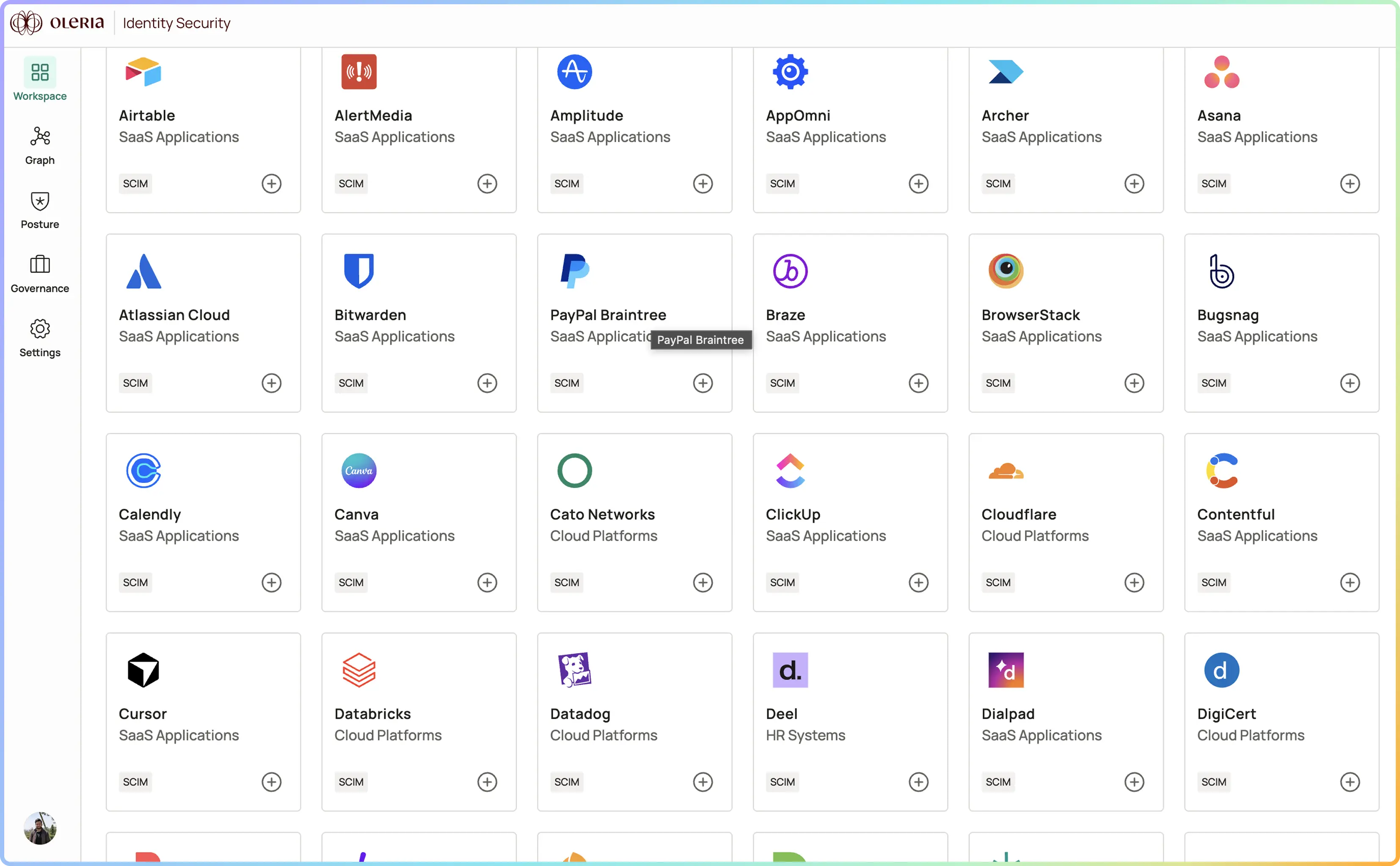
Oleria connects to your SaaS stack at two depths, and every app - regardless of connector type - flows into the same identity graph, governance workflows, and IGA programs. This two-tier approach to SaaS identity governance without connector backlog means you get meaningful coverage across 200+ apps without the multi-year engineering investment traditional IGA platforms require.
For the apps that matter most, Oleria builds full custom connectors that pull complete RBAC graphs, role definitions, permission inheritance, service account details, and activity logs. Nothing is approximated.
For the remaining apps, Oleria's SCIM connector framework connects in days. You get identity inventory, group membership, RBAC data at SCIM depth, and the ability to run provisioning and deprovisioning workflows through the standard SCIM 2.0 protocol.
Every app in your inventory is tagged with its connector depth - "Custom (deep)" or "SCIM (breadth)." The team knows what governance fidelity to expect from each app and plans access reviews accordingly.
Deep and SCIM-connected apps live in the same graph. Access reviews, certifications, and deprovisioning workflows run across all of them. Coverage gaps don't hide behind connector type.
Sync hygiene. Sync failures, schema drift, and deprovisioning gaps surface in a unified queue regardless of connector type. SCIM connectors get the same operational care as deep connectors.
The security team runs a quarterly access review. Custom-connected apps - Salesforce, GitHub, AWS - show full RBAC graphs: every role, every permission, every user who holds it. The access certification is precise.
The long-tail apps used to be excluded from the review entirely because there was no way to pull structured access data. With SCIM connectors in place, those 180 apps now surface in the same certification workflow - user, group, access level, last sync. The reviewer can attest or revoke. The contractor account sitting in that acquired company's project management tool gets caught. The admin role granted during an incident and never removed gets flagged.
The long tail isn't invisible anymore.

Okta provisions identities to apps. Oleria governs the identities and RBAC inside the app - running access reviews, flagging over-provisioned accounts, and enforcing deprovisioning. Different jobs, complementary. SCIM is the substrate; what you do with the data afterward is the platform.
SCIM 2.0 exposes users, groups, and group membership. For apps that extend SCIM with entitlement schemas, Oleria pulls those too. What SCIM does not reliably expose is fine-grained permission levels, role inheritance graphs, or activity - that depth requires a custom connector.
Most SCIM implementations have quirks. The connector framework handles common deviations. For very non-standard implementations, the path is a custom connector rather than SCIM.
Yes. Access certifications, access reviews, and deprovisioning workflows run against all connected apps regardless of connector type. The reviewer sees user, group, access level, and last sync timestamp. Depth is labeled so the reviewer knows what they are attesting to.
Yes - read for discovery, write for provisioning where the app supports it. Write actions are opt-in per workflow.