Introducing Maestro: Oleria’s Zero Trust Identity Security for AI Agents
Governed, identity-first security for deploying autonomous AI agents in the enterprise, the layer that lets you say yes to agent autonomy without giving up control.
%20(1).avif)
Featured event: A CISO’s take
Join Jim Alkove and Ramy Houssaini to learn how forward-thinking security teams are addressing Enterprise AI Copilot risks.
Enterprises are ready to put AI agents to work - but not at the cost of control. An autonomous agent that can read systems, call tools, move data, or change configuration is, from a security standpoint, a new kind of identity: fast, prolific, and capable of acting without a human watching every step. So the question every security leader is now asking is a simple one: how do we say yes to agent autonomy without giving up governance?
That is the question Oleria's Maestro was built to answer.
Oleria's Maestro: a governed agentic operating system
Maestro runs autonomous AI agents under continuous identity, authorization, isolation, and human-in-the-loop control - with a complete, attributable record of every action and the reasoning behind it. Five ideas define it:
- Safe autonomy. Agents act under least-agency, deny-by-default scopes. Every action is authorized at the moment it happens - not granted once and forgotten.
- Identity-first. Every agent carries a governed identity; every action is attributed, policy-checked, and auditable.
- Containment by design. Per-action policy plus hardware-grade isolation cap the blast radius of any compromise.
- Accountable orchestration. A society of agents coordinated through one auditable control point, with humans in the loop on the decisions that matter.
- The "why," not just the "what." A recorded rationale for every action, captured before it runs - so you can audit intent, not just outcomes.
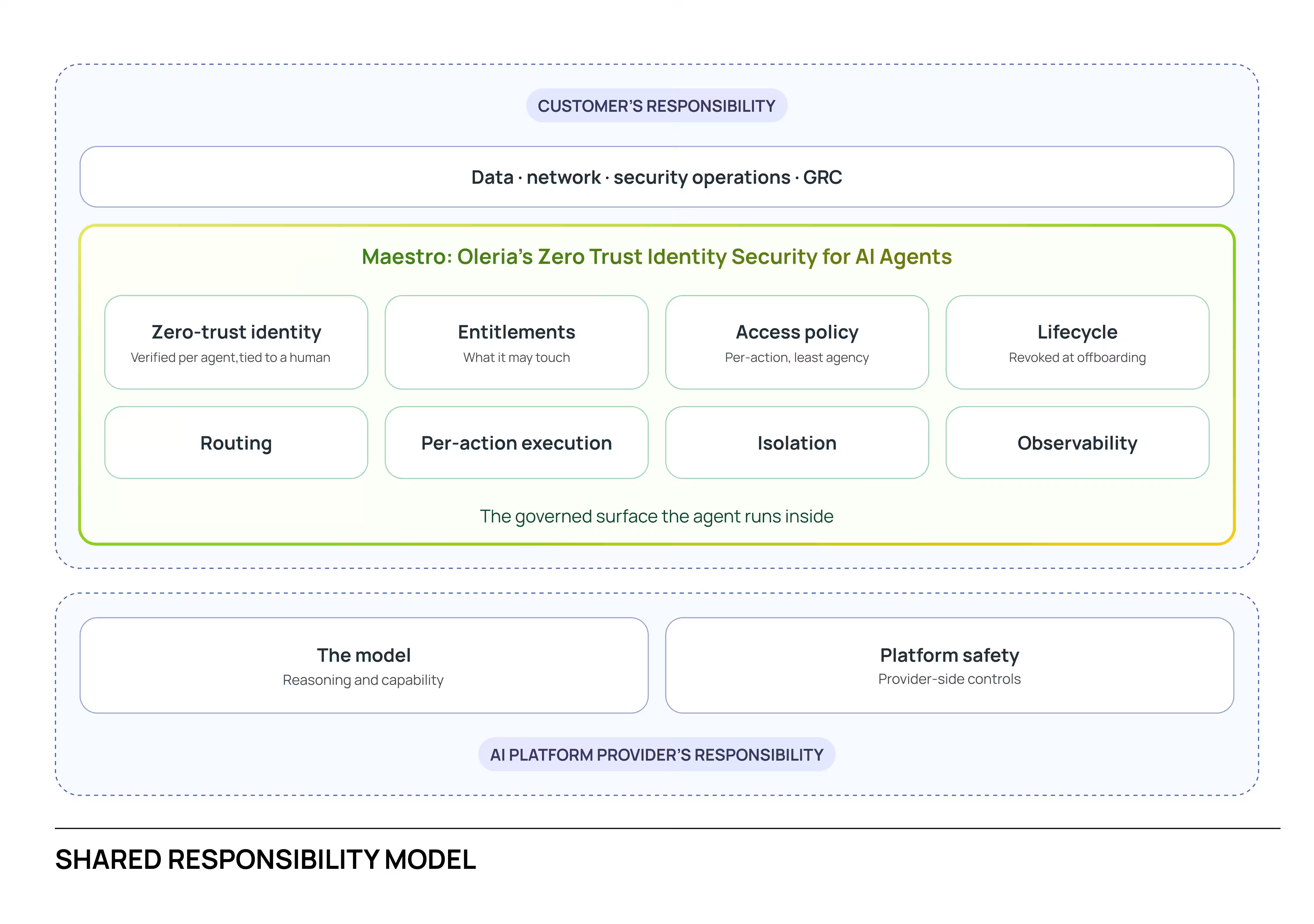
The customer's responsibility, above the agent-provider platform
The agent and the agent-provider's platform - is not where the enterprise's responsibility ends. Safe deployment demands a governance layer above the provider platform: the customer's responsibility, and one no single agent can enforce for itself. That layer has to provide:
- Verifiable identity for every agent - you can't govern what you can't attribute.
- Least-agency authorization, per action - scoped to the task, not standing permissions.
- Isolation and blast-radius containment - for when, not if, an agent is compromised.
- Observability with intent - what happened, why, and who authorized it.
- Policy and human-in-the-loop at the decision points that carry real consequence.
- Multi-agent trust boundaries - no privilege inheritance, no confused deputy across a fleet of agents.
Zero Trust for AI agents is a platform responsibility, not an agent feature. That's the layer Oleria delivers for the enterprise.
Where the line falls, and how Maestro holds the customer’s side
Anthropic provided the framework - Maestro delivers the platform. The industry is converging on this view. Anthropic, a key agent-platform vendor, recently published Zero Trust for AI Agents, a tiered framework that maps directly to this responsibility model. It is a useful yardstick, and a validating one: a platform provider naming the governance responsibilities that sit above the model, on the customer’s side of the line. Before the how, it helps to see the where.
The identity-security foundation for Zero Trust
Built in layers, the agent when combined with Oleria's Maestro governance and orchestration, bring capabilities the framework doesn't even name:
- Proof of Attention. Verifiable evidence that an agent attended to a contract before it can act and fail-closed when that evidence is absent.
- A rationale layer. A logged justification for every action, captured before it runs frames the "why," always on.
- Structural multi-agent routing. No direct peer-to-peer delegation, so confused-deputy and privilege-inheritance risks are closed by the architecture itself.
- Governed capability admission. New agent tools pass a human-gated pipeline inspection, tests provenance before they're ever called.
- Context & memory architecture. Tiered context plus durable cross-session memory and proactive, controlled restart - continuity without context bloat or drift.
- Self-improving governance. The system mines its own action-rationale for anomalies, capability gaps, and good patterns.
The End-to-End Oleria Stack
One integrated identity security platform delivered end-to-end
Zero Trust for agents is met by the Oleria platform as an integrated whole - not by a collection of point tools, and not by the agent alone:
Maestro is Oleria’s governed surface for enterprise AI agents. It gives every agent a verified identity, authorizes each action against the customer’s policy, isolates the agent so a compromise stays contained, and records what happened and why. Maestro delivers the customer’s side of the shared responsibility model for AI agents, across both identity and the secure runtime.
It divides security into two parts. The AI platform provider secures the model: its reasoning, capability, and platform-side safety. The enterprise secures everything the agent runs inside: its identity, what it is authorized to do, and the secure runtime that routes, executes, isolates, and observes its actions. It mirrors the cloud shared responsibility model, where the provider secures the cloud and the customer secures what they put in it.
FREQUENTLY ASKED QUESTIONS
What is Trustguardian?
Trustguardian is Oleria’s identity layer for AI agents. It provides cryptographic, per-agent non-human identity, along with credentials, authorization profiles, and organizational policy. It is the identity backbone the rest of the platform builds on, so every agent action can be attributed to a verified identity and checked against policy.
What is Trustfusion?
Trustfusion is Oleria’s usage-aware identity security platform, the foundation beneath the agentic governance story. It provides the entitlement and identity context, drawn from the enterprise identity graph, that makes governing AI agents possible. You cannot govern what you cannot attribute, and Trustfusion supplies the attribution.
Who is responsible for AI agent identity, the platform or the customer?
The customer. An AI agent acts on behalf of a human or function inside the enterprise, so governing it depends on identity context the platform does not have: who the agent acts for, what it is entitled to touch, and what happens when its owner leaves. That context lives in the enterprise identity graph, which makes agent identity, authorization, and lifecycle the customer’s responsibility.
What is zero trust for AI agents?
Zero trust for AI agents applies zero-trust principles, never trust, always verify, least privilege, to autonomous agents. Every agent is verified, every action is authorized at the moment it happens, and nothing is granted by default. The shared responsibility model answers who implements those principles: the platform secures the model, and the enterprise secures the identity and secure runtime of what the agent does in its environment.
Go deeper: the Maestro technical paper
Maestro: Oleria's agentic operating system
The full architecture: identity, the secure runtime, and the primitives beyond today's frameworks.
Four questions every CISO will be asked about AI agents in 2026

Heading