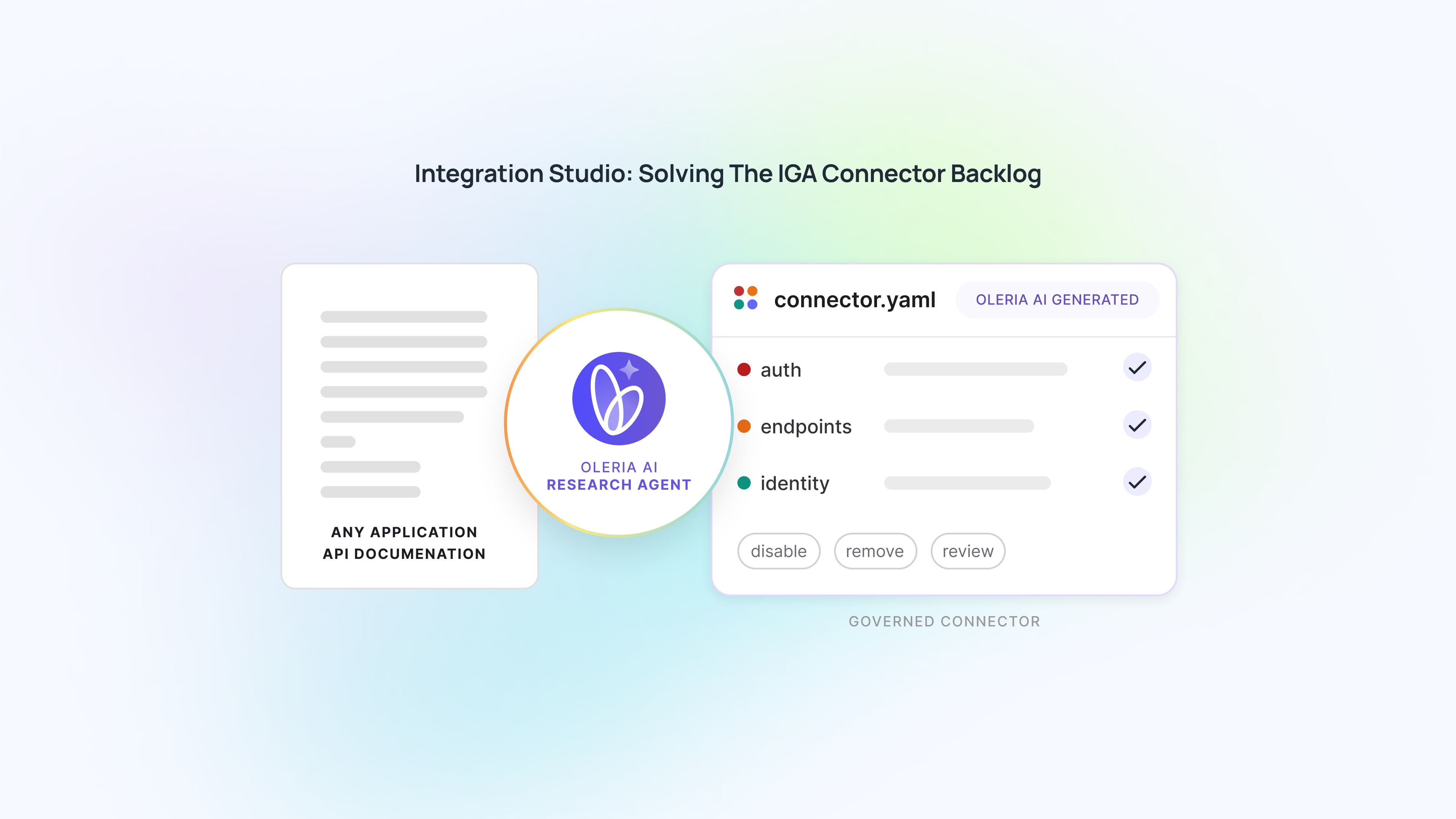
Identity lifecycle management: the complete guide to joiner-mover-leaver automation
Automate identity lifecycle management with joiner-mover-leaver workflows. Eliminate ticketing system delays, create unified audit trails, and reduce manual provisioning work.
.avif)

Key Takeaways
- Joiner-mover-leaver automation provisions the right access on day one, adjusts entitlements when roles change, and removes all access at offboarding, eliminating the ticketing delays that produce orphaned accounts and access creep.
- Oleria connects HR system events directly to provisioning actions across all integrated SaaS and on-premises applications, generating a unified audit trail that satisfies SOX, ISO 27001, and SOC 2 requirements.
- Manual lifecycle management leaves departed employee accounts active for weeks and accumulates unreviewed entitlements with every unmapped role change, creating compounding identity risk.
- Automating identity lifecycle eliminates the access creep that makes annual certification campaigns necessary by keeping entitlements continuously aligned with current role requirements.
This summary was created with AI and reviewed by an editor.

Ask AI to write a summary


Featured event: A CISO’s take
Join Jim Alkove and Ramy Houssaini to learn how forward-thinking security teams are addressing Enterprise AI Copilot risks.
Identity lifecycle management underpins modern access governance. However, many organizations treat it as a set of siloed processes instead of one unified system, leading to access sprawl, compliance gaps, and inefficient manual work.
This guide explains identity lifecycle management, its importance, and how automation can reduce operational burden while enhancing security.
The JML process TL;DR:
The Joiner-Mover-Leaver (JML) lifecycle framework automates how user access changes over time:
- Joiner (Onboarding): Instantly provisions birthright access bundles on Day 1.
- Mover (Role Changes): Dynamically alters entitlements to halt permission creep.
- Leaver (Offboarding): Immediately revokes cross-platform access to eliminate orphaned account vulnerabilities.
What is the joiner mover leaver (JML) process in IAM?
Identity lifecycle management, which is often operationalized as the Joiner-Mover-Leaver (JML) process, is the automated framework that governs user access from initial onboarding through internal transfers and final departure.
While legacy systems treat this strictly as a human workforce routing problem, modern JML automation must secure both human employees and non-human identities (NHIs) such as API tokens, service accounts, and agentic AI tools.
The lifecycle consists of three distinct phases: joiner (onboarding), mover (role changes), and leaver (offboarding). Each phase presents unique operational challenges. Joiners require prompt provisioning without excess access. Movers risk accumulating unnecessary permissions over time. Leavers pose significant risk if access is not fully and promptly revoked.
Without structured identity lifecycle management, organizations experience risky access sprawl. Over 95% of multi-cloud permissions remain unused, increasing risk without providing any business benefit. Manual reviews, spreadsheets, and ticketing systems create bottlenecks and oversight gaps.
The three pillars of joiner, mover, and leaver process automation
Each component of identity lifecycle management targets a specific challenge within the access lifecycle.
Joiners: Accelerating onboarding without excess access
When a new employee starts, they need access to the tools and systems required for their role. This should happen on day one instead of weeks later. Traditional onboarding often involves manual requests, IT tickets, and back and forth communication, all while the employee waits idly. Many organizations default to over-provisioned "just in case" access, accepting risk to get new employees up and running more quickly.
Modern identity lifecycle management accelerates onboarding without over-provisioning by using automation through access bundles. These are predefined sets of applications and groups mapped to job roles, departments, or locations. For example, an admin defines that all sales engineers in the EMEA region should get access to Salesforce, Slack, and specific cloud repositories. When a new employee is added to that department and location, these permissions are provisioned automatically.
Maintaining up-to-date access bundles is challenging, as static rules quickly become outdated. Adaptive recommendation systems address this by analyzing peer data and usage patterns, suggesting the removal of rarely used tools and the inclusion of new, widely adopted ones. This ensures new joiners receive relevant access.
Movers: Managing role transitions without permission creep
When employees change roles, their access should be updated accordingly. In practice, they often retain previous permissions while gaining new ones, leading to accumulated access and expanded risk over time.
Identity lifecycle management streamlines role changes by automatically updating access when HR records change. For example, moving from marketing to product management triggers the revocation of old access and the provisioning of new, role-specific permissions. Clear policies and automated workflows ensure consistency.
The same adaptive recommendation logic applies here. As employees move between roles, the system can recommend which legacy permissions to remove based on usage and peer comparisons. Did the person ever actually use the old access? Do others in their new role have it? These signals help ensure transitions are clean and complete.
Leavers: Ensuring complete and timely offboarding
When employees leave, their access must be fully and promptly revoked. Many organizations struggle to coordinate this across multiple systems, and incomplete offboarding leads to orphaned accounts, dormant access, and security risks.
Identity lifecycle management automates offboarding with structured, automated workflows. When HR records a termination date, the platform triggers notifications, coordinates access removal, and verifies completion.
Offboarding must address both voluntary and involuntary departures. Planned exits follow a timeline, while immediate terminations require rapid access removal. Identity lifecycle management should support both scenarios, including bulk deprovisioning when necessary.
Modern identity lifecycle management stands out by providing post-departure visibility. Instead of assuming access removal is complete, it monitors departing employees’ identities for a set period to detect reactivated accounts or lingering access. This ensures comprehensive offboarding and a complete audit trail.
Why identity lifecycle management matters for security and compliance
The top identity management challenges that organizations face, according to 451 Research's Voice of the Enterprise survey, are managing privileged access, ensuring employees have appropriate access, managing developer and admin accounts, and conducting user access reviews. These are precisely what identity lifecycle management is designed to solve.
Yet only 42% of enterprises have deployed standard IGA tools, well below other security staples like firewalls (83%), email security (74%), and SIEM tools (67%). This disconnect exists because legacy solutions carry a heavy implementation tax: they're expensive, difficult to deploy, and require ongoing specialized expertise to maintain. Read more here.
The security case for identity lifecycle management is clear: Incomplete access removal during offboarding leaves behind credentials and permissions that attackers can exploit. Over-provisioning during onboarding unnecessarily expands the attack surface. Unmanaged access accumulation during tenure creates dormant permissions that pose risk without adding value.
The compliance case is equally important. Regulations, including SOX, HIPAA, PCI DSS, and ISO 27001 all require evidence that access is regularly reviewed, documented, and appropriate. Identity lifecycle management produces audit-ready records of provisioning decisions, access reviews, and deprovisioning actions. This demonstrates a defensible security posture during regulatory audits.
How joiner-mover-leaver automation eliminates manual IT overhead
The operational burden of manually managing the identity lifecycle is substantial. IT teams spend time coordinating with HR systems, tracking termination dates, and following up on incomplete requests. Managers spend time reviewing access lists that lack context, often rubber-stamping approvals without a real understanding of whether access is still needed. Security teams struggle to verify that offboarding was complete across all systems.
Many organizations use ticketing systems like ServiceNow or Jira for access provisioning and revocation, though these tools are not designed for identity lifecycle management. Ticketing introduces delays, incomplete updates, and fragmented audit trails, making compliance difficult to demonstrate.
Why ticketing systems (Jira/ServiceNow) leave dangerous JML gaps
Many enterprises rely on standard ticketing systems to manage JML changes. However, ticketing introduces static, disconnected workflows. Tickets create manual execution delays, rely heavily on human confirmation, and fail to track what an identity actually does with access after it is provisioned. True operational security requires real-time, API-driven system automation instead of an endless queue of IT helpdesk tickets.
Faster time-to-productivity
Modern identity lifecycle management platforms integrate directly with identity providers and applications, automating workflows at machine speed. Access is provisioned, updated, or revoked instantly as employees join, move, or leave, eliminating manual bottlenecks.
This automation significantly improves time-to-productivity. New employees are productive on day one, and departing employees are fully deprovisioned within minutes, rather than waiting days or weeks. These efficiency gains increase with scale. While ticketing systems may suffice for small organizations, they become bottlenecks as access changes grow. Automated provisioning with unified audit trails scales efficiently without added overhead.
Streamlined auditability and reduced risk
A unified audit trail is essential. Unlike ticketing systems that scatter evidence, modern platforms track every provisioning and revocation decision in one place, making compliance reporting straightforward and defensible.
Automation provides operational benefits beyond speed and auditability by eliminating manual tracking and reducing the risk of lost or incomplete requests. Automated workflows ensure all access changes are properly managed and reduce human error. Automated workflows consistently follow defined rules, minimizing access errors and the need for remediation.
4-step JML automation framework
Implementing identity lifecycle management effectively requires structured, data-driven attention. To outpace the limitations of legacy processes, prioritize this four-step strategy:
Common challenges in identity lifecycle management implementation
Organizations implementing identity lifecycle management encounter several predictable obstacles.
Fragmented identity data
Identity and access information lives in multiple systems, including HR databases, identity providers, cloud platforms, on-premises systems, and individual applications. Consolidating this data is time-consuming and error-prone. Without a unified view, lifecycle management remains incomplete because you can't see all access that needs to be managed.
Stale policies and access bundles
Static access policies quickly become outdated as business needs evolve. An access bundle defined six months ago may no longer reflect what new employees actually need. Without continuous updating, lifecycle management becomes an exercise in maintaining legacy decisions rather than enabling current business needs.
Incomplete offboarding
Many organizations remove access from primary systems but miss secondary access: shared drives, email distribution lists, VPN access, physical security, and vendor systems. The departing employee appears to be fully offboarded but retains access in unexpected places. Monitoring for post-departure access attempts helps catch these gaps.
Review fatigue
When managers review access lists without context, they often approve quickly without genuine evaluation. They don't know if the access is actually being used, how it compares to peers, or whether it's still appropriate. This rubber-stamping defeats the purpose of access reviews. Providing context transforms reviews from compliance exercises into real security decisions.
Integration challenges
Connecting lifecycle management to all the systems in your environment is complex. Some systems have good APIs, while others require custom integrations or manual coordination. Building connectors for every application is expensive. Prioritizing which systems to integrate first and accepting that some manual processes may persist is part of realistic implementation.
Evaluating modern JML automation solutions
The market for identity lifecycle management solutions has matured to address the limitations of conventional tools like legacy IGA platforms that required lengthy implementations and specialized expertise. Newer vendors are building solutions that deliver core lifecycle management capabilities without the traditional implementation burden.
When evaluating solutions, consider deployment speed, unified visibility, context-aware recommendations, compatibility with your systems, and total cost of ownership, including implementation and maintenance.
Solutions vary in automation and auditability. Some offer only basic automation and manual verification, while others provide usage data, peer comparisons, and dormancy indicators. Some are limited to one ecosystem, while others support cross-platform visibility and unified audit trails.
The most effective solutions combine automation, intelligence, and unified audit capabilities. They integrate directly with systems, provide context and recommendations, adapt to changing environments, and create comprehensive audit trails for straightforward compliance reporting.
Getting started: Your identity lifecycle management strategy
If your organization is beginning to implement identity lifecycle management or seeking to improve your current approach, start with these questions:
- Do you have visibility into the full employee lifecycle? Can you track what happens from hire through departure?
- Are your current processes manual and time-consuming, or are they already automated? Where do manual steps and ticketing systems create bottlenecks?
- How complete is your offboarding? Do you have visibility into whether access is actually being removed across all systems?
- What's your current state of access sprawl? Are employees accumulating unnecessary permissions over time?
- Can you generate audit evidence that access is regularly reviewed and appropriate? Or is compliance reporting a scramble to collect evidence from multiple systems?
Your approach should align with your current state and priorities. Some organizations begin with offboarding automation to address high-risk departures, while others focus on joiner automation for productivity. Addressing all three phases as a unified system yields the greatest benefit.
How identity lifecycle management strengthens identity security posture
Identity lifecycle management is foundational to a modern security posture. It's not a project that's ever fully "done" but an ongoing practice that evolves as your organization, systems, and threats change. Starting with visibility, establishing clear policies, and implementing automation that reduces manual work and creates unified audit trails creates a foundation for continuous improvement.
Organizations that implement effective identity lifecycle management achieve faster onboarding, cleaner offboarding, reduced manual work, and comprehensive audit trails. They also benefit from improved security, clearer compliance, and faster response to access issues, making the investment worthwhile.
To explore how modern identity lifecycle management can work in your environment, consider evaluating solutions that combine automation with context-aware intelligence and unified audit capabilities. The most effective platforms reduce manual work and eliminate ticketing system bottlenecks without sacrificing the visibility and control that security teams need.
Ready to strengthen your identity lifecycle management? Oleria automates joiner, mover, and leaver workflows while providing the context and visibility needed to make informed access decisions. With unified audit trails and direct system integration, organizations eliminate ticketing system delays and create defensible compliance evidence. See how organizations are reducing manual work and improving security through modern identity lifecycle management. Schedule a demo with Oleria today.
Top 10 IGA vendors in 2026: a practical guide to modern identity governance

Heading